



Shanghai cleans up waste collection, recycling









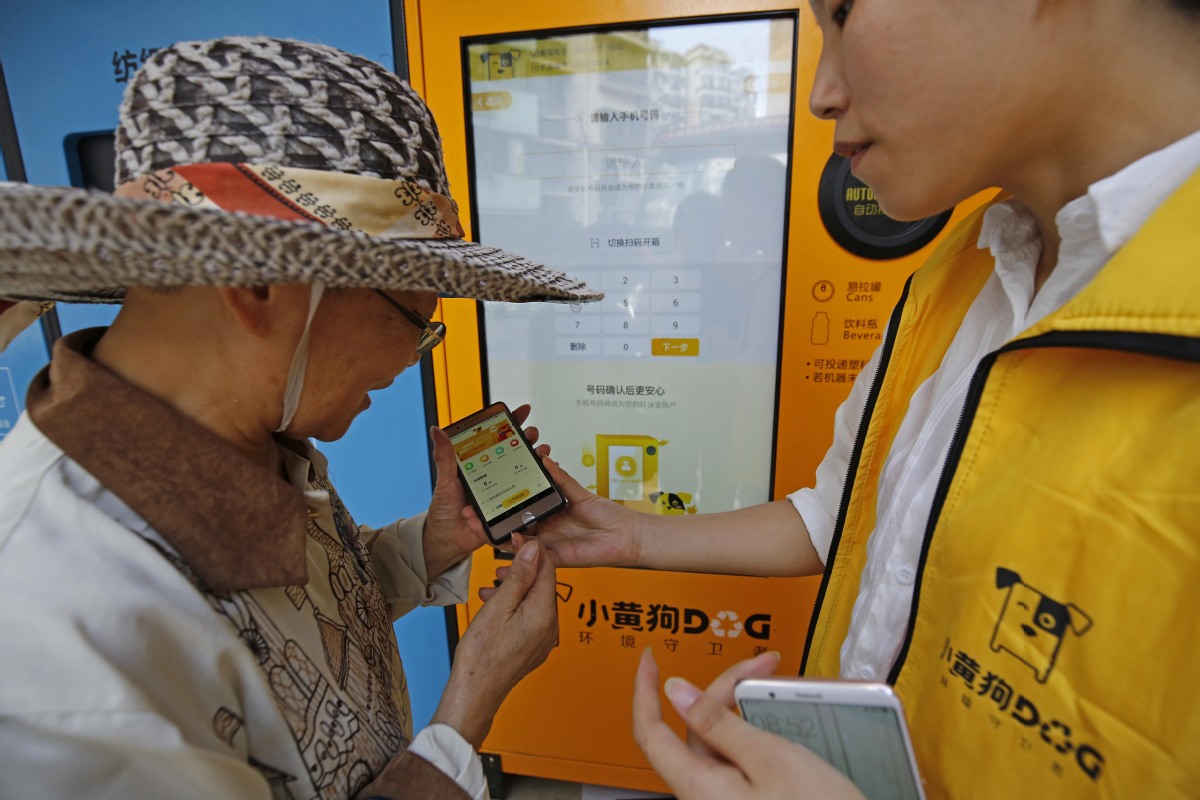
Long-term action plan
In March, the Shanghai municipal government published an action plan to implement the sorting of household waste across the city, and made it clear that every residential community in every district would be required to operate a trash sorting program by 2020.
The aim is to reduce the daily volume of dry waste from 21,400 metric tons to 18,100 tons.
Meanwhile, the amount of wet waste, mainly kitchen leftovers, which can be reused as compost or fertilizer, must be increased from 3,480 tons to 6,300 tons a day, and the daily volume of recyclables, including plastics and papers, should rise from 660 tons to 1,100 tons.
"Trash sorting is an important step in achieving harmless treatment and effective disposal of solid waste," said Liu Chang, deputy chief engineer at the Ministry of Housing and Urban-Rural Development's Environmental Sanitation Engineering Technology Research Center.
Currently, landfills and incineration are the dominant methods of treating waste in China, but properly sorted trash can save space in landfills, which have a limited area, while certain types of dry waste can be burned as fuel for incineration plants.
"The amount of household waste produced in China is rising every year, and the solid waste treatment industry is developing at high speed as well," Liu said.
"But there is still a huge gap between the waste we produce and our ability to treat it," he added, estimating the shortfall at about 30,000 tons a day.
"Sorting our trash will help to close the gap."


- Video of monkeys escaping rain in Guizhou goes viral
- Authorities expose eight cases of illegal land use and ecological damage
- Travel by Shanghai residents to Jinmen, Matsu set to resume
- Young technicians tackle ice in railway tunnels for safe train services
- China's urban-rural income gap narrows
- 62,000 people charged for telecom fraud from Jan-Nov in 2025