



Shanghai takes measures to make testing easier









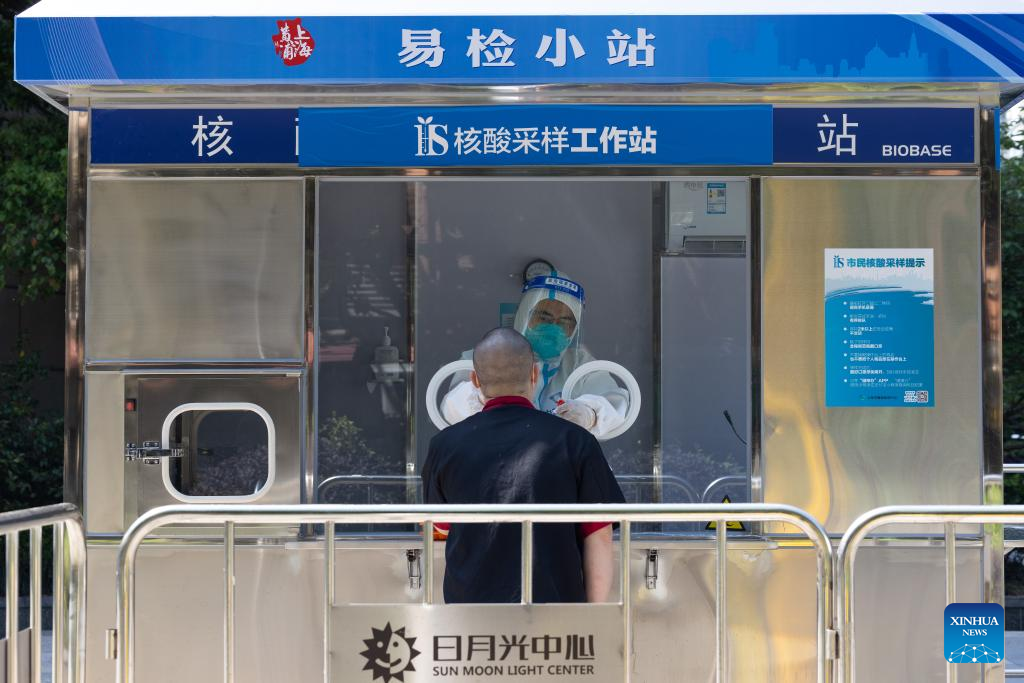
Shanghai will make routine nucleic acid tests more accessible to citizens by adding testing stations and prolonging service hours.
Over 10,000 regular testing stations have been set up in the city as of June 1, local authorities said at a media briefing on Thursday.
A negative test taken within 72 hours is required for different facets of public life in Shanghai, such as grocery shopping or taking public transportation.
The government is taking action on issues ranging from long queues to insufficient testing resources, said Xia Kejia, who heads the nucleic acid test team for the city's epidemic prevention and control.
Improvement measures include the establishment of targeted testing booths to residential compounds, commercial and industrial parks, office buildings and large-scale corporations.
More personnel will be allocated to conduct tests, while operating hours are expected to be prolonged with the addition of 24-hour testing venues.
Efforts should also be made to minimize delay in sampling, delivery, testing and reporting results, and an emergency response mechanism shall be established and optimized.
The city reported seven new infections on Thursday. All three confirmed patients and four asymptomatic cases have been sent to designated hospitals for treatment or medical observation.
Gene sequencing is being carried out on the positive cases in Pudong New Area, according to Wu Jinglei, director of the Shanghai Municipal Health Commission. The dominant subvariants of the city's resurgence over the past two months remained Omicron BA.2 and BA.2.2.


- A special school for humanoid robots
- Xi inspects Xiong'an New Area in North China's Hebei
- Xi congratulates Thongloun on re-election as president of Laos
- Two students killed, 14 injured in Guizhou traffic accident
- China records a big rise in bringing patents from universities and research centers to market
- Splendid auroras witnessed in NE China's Heilongjiang





