
Shandong strengthens trade ties with SCO countries
(chinadaily.com.cn)| Updated : 2025-12-18
Print Print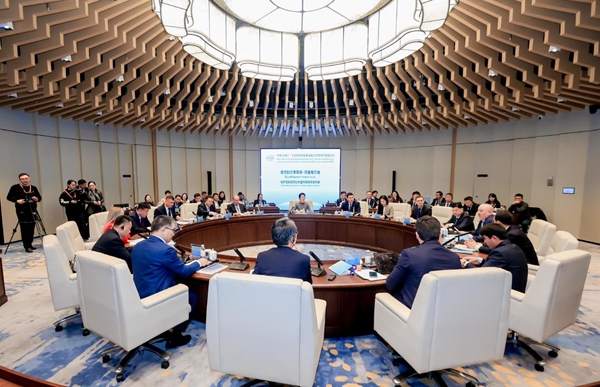
The round-table conference on China-Shanghai Cooperation Organization local economic and trade is held in Qingdao, East China's Shandong province. [Photo/Dazhong News]
A series of conferences on China-Shanghai Cooperation Organization (SCO) local economic and trade, special economic zone, and industry value and supply chain cooperation was held in the China-SCO Local Economic and Trade Cooperation Demonstration Area (SCODA) in Qingdao, Shandong, on Dec 17.
These conferences aimed to improve the local economic and trade cooperation and deepen practical economic and trade exchanges between Shandong and the SCO member countries.
Shandong attaches great importance to developing partnerships with SCO countries, and in the first three months of this year, trade between Shandong and SCO countries hit $62.17 billion, a 12.8 percent increase.
At the industry value and supply chain conference, Shandong signed economic and trade cooperation memorandums with investment and trade departments from Naryn in Kyrgyzstan, Fergana in Uzbekistan, and Mogilev in Belarus.
The conference had business matchmaking in key areas, like platform supermarkets, petrochemicals, engineering equipment, building materials, agricultural food, and textiles, with over 180 local and international companies participating in one-on-one talks.
SCO Deputy Secretary-General Dai Size highlighted the importance of this cooperation. Shandong, with its strong industry, advanced technology, and strategic location, is a key partner for SCO countries.
SCODA has become a major hub for cultural exchange, economic resources, and big events for SCO countries. It was named a "special economic zone" at the SCO Tianjin Summit this September. It will focus on enhancing infrastructure, platforms, and industrial collaboration to keep supply chains stable and efficient.
 Xi's Moments
  Voice your opinions on China's 2026 Government Work Report
  Shandong advances into new five-year plan period