



Steel demand seen buoyed by autos, appliances in '26









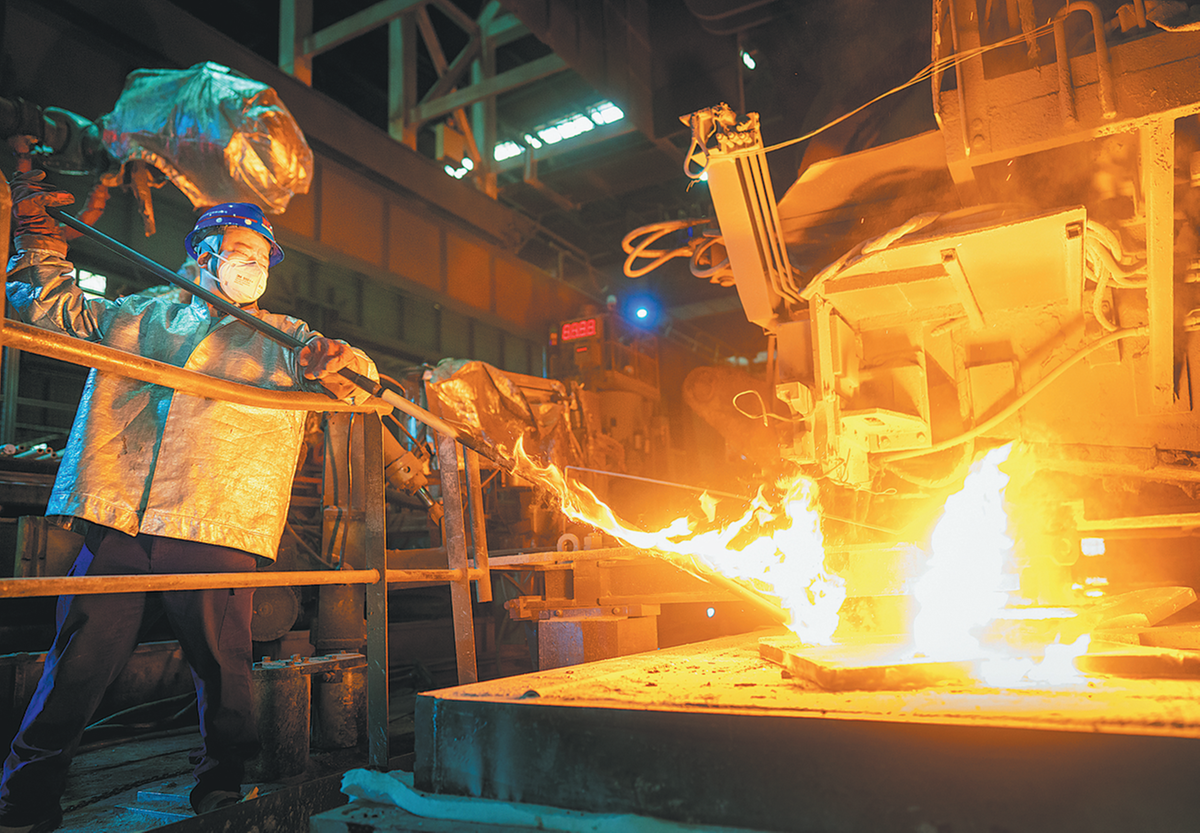
China's steel demand is holding firm in key sectors such as new energy vehicles, automobiles and home appliances, reflecting a shift toward higher-quality industrial consumption, even as overall demand is projected to gradually decline over the next two years, according to a report.
The report released by the China Metallurgical Industry Planning and Research Institute shows that China's steel consumption is expected to reach 808 million metric tons in 2025, down 5.4 percent year-on-year, while steel demand in 2026 is forecast at 800 million tons, a 1 percent decline.
Despite the overall downward trend, steel consumption in sectors such as automobiles, motorcycles, shipbuilding and home appliances is expected to continue rising in both 2025 and 2026.
According to the report, steel consumption in the automotive sector will total 63.9 million tons in 2025, up 10.9 percent year-on-year.
Taking into account output changes across different vehicle segments as well as the rising share of NEVs, steel demand from the automotive sector is projected to reach 66.7 million tons in 2026, representing 4.4 percent growth, the report said.
The institute attributed the sector's positive momentum to the steady operation of the broader economy, as well as the combined effect of promoting large-scale equipment upgrades, trade-in of consumer goods, and local replacement subsidy programs.
"These factors have helped sustain healthy growth in the automotive industry, with the passenger vehicle market expanding steadily, the commercial vehicle market recovering, NEVs growing at a relatively fast pace, and foreign trade demonstrating strong resilience," it said.
Furthermore, even with a complex international trade environment, the home appliance industry showed notable resilience in 2025, maintaining steady growth supported by trade-in policies.
According to the report, steel consumption in the home appliance sector is estimated at about 18.2 million tons in 2025, up 1.7 percent year-on-year, while demand is forecast to reach 18.9 million tons in 2026, representing 3.8 percent growth.
Xiao Bangguo, president of the institute, said China's steel industry should seize opportunities arising from adjustments in demand structure, but must first develop a correct understanding of product structure optimization, which should focus on high-quality development, targeting products that are both in demand and profitable, and avoiding blind pursuit of high-end positioning.
Xiao said the product structure adjustment at steel enterprises should follow three principles — gaining a clear understanding of changes in demand for different products, aligning adjustments with each company's development characteristics and surrounding market demand, and ensuring stable product quality.
"Going forward, enterprises should deepen specialization and promote scale development on that basis, leveraging scale to achieve lower costs and enhance value creation and market competitiveness through strong brand building,"Xiao said.
As the scope of industrial chain extension continues to expand, he also suggested that steel enterprises promote the development of collaboration-centered industrial ecosystems, making them a key lever for advancing intelligent, green and integrated development.
Alongside structural and strategic adjustments, the institute also examined how steel companies are performing in terms of environmental, social and governance standards.
The institute released ESG ratings for domestic steel enterprises in 2025, covering 108 companies, whose combined crude steel output accounted for about 82.8 percent of the national total.
In 2025, ESG information disclosure and ratings in the steel industry showed a positive trend of both quantitative and qualitative improvement, the report said. The number of enterprises releasing ESG reports continued to grow, while leading companies achieved full ESG disclosure coverage and significantly improved the completeness of report content and data.
However, the overall ESG performance of the industry still shows clear differentiation, with leading companies setting the pace, mid-tier firms catching up and lagging players needing improvement. "Going forward, stronger industry-wide ESG coordination mechanisms along the industrial chain are needed to raise the overall ESG level of the sector," it said.


Today's Top News
- Xi urges basic research push for original innovations
- Building of rare earth hub highlighted
- Seedance 2.0 signals big shift in AI sector
- United front work urged to pool strength
- Beijing refutes US nuclear test accusations
- Xi sends festive greetings to all service personnel







