



Ministry seeks to tighten air quality norms
Proposed revision aims to protect public health, advance low-carbon transition









The Ministry of Ecology and Environment has proposed significantly tightening national air quality standards, a move aimed at further protecting public health after years of sustained improvement in the country's air quality.
According to a draft of the revised standards, the annual average concentration of fine particulate matter with a diameter of 2.5 micrometers, or PM2.5, under the secondary standard would be lowered from 35 micrograms per cubic meter to 25 micrograms per cubic meter. The daily limit would be reduced to 50 micrograms per cubic meter from the current 75.
The draft also proposes stricter limits for PM10, lowering its annual and daily secondary standards to 50 and 100 micrograms per cubic meter, respectively, from the previous 70 and 150.
The ministry plans to implement the changes in two phases, with transitional limits applied from 2026 to 2030. During that period, the annual and daily limits under the secondary standard would be set at 30 and 60 micrograms per cubic meter for PM2.5, and 60 and 120 micrograms per cubic meter for PM10.
Pei Xiaofei, ministry spokesman, said at a news conference on Friday that the phased approach is intended to mitigate the impact of the stricter standards on the economy and society, ensuring a smooth transition while maintaining stable socioeconomic operations.
He added that, based on previous experience, the revision would not only significantly improve air quality nationwide but also promote high-quality economic development.
The current secondary standard was introduced in 2012. Since 2015,China's nationwide annual average PM2.5 concentration has fallen by 36 percent, while the number of days with heavy pollution has dropped by 68 percent, Pei said.
Over the same period, he noted, the economy continued to expand. China's GDP grew by 63 percent, and the number of vehicles rose by 111 percent.
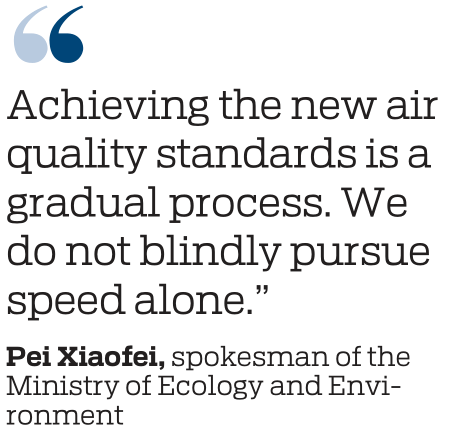
"Achieving the new air quality standards is a gradual process. We do not blindly pursue speed alone,"Pei said.
After the new standards are adopted, supporting policies and emission standards for relevant industries will be updated gradually, he said.
Necessary funding, technology and methodological support will also be rolled out progressively.
From a long-term perspective, Pei said the tighter standards will improve public well-being while accelerating the country's green and low-carbon transition.
The revision is expected to further reduce PM2.5 concentrations, lowering the risks of acute incidents and hospitalizations related to cardiovascular and respiratory diseases, he said.
It is also anticipated to help spur the development of new quality productive forces, including new energy vehicles and clean energy.
In addition, Pei said the proposed changes will accelerate the adoption of advanced processes in industries such as metallurgy, building materials and petrochemicals, while promoting greener, low-carbon transformations in industry and transportation, as well as in the energy consumption mix.





Today's Top News
- Washington should realize its interference in Taiwan question is a recipe it won't want to eat: China Daily editorial
- Responsible role in mediating regional conflict: China Daily editorial
- US?arms sale only a?'bomb' to Taiwan
- China-Cambodia-Thailand foreign ministers' meeting reaches three-point consensus
- Drills demonstrate China's resolve to defend sovereignty against external interference
- Trump says 'a lot closer' to Ukraine peace deal