



New Beijing rail station to be a major transport hub









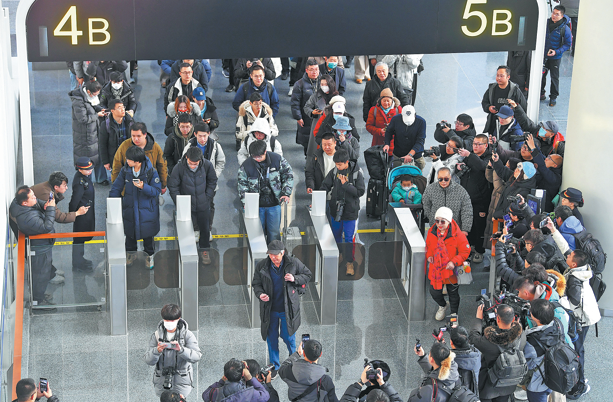
Beijing's Tongzhou Railway Station opened on Tuesday as a major underground transport hub in the eastern Tongzhou district, expanding rail connections between Beijing and neighboring cities in Hebei province and Tianjin.
The station serves as the primary railway terminal for Beijing's Municipal Administrative Center and is part of broader efforts to strengthen regional rail connectivity and support development of the capital's eastern subcenter.
The first train departed Tongzhou at 10 am for Tangshan, Hebei, completing the journey in 55 minutes. Services from the new station also link to Tianjin's Baodi and Beichen districts, as well as Qinhuangdao in Hebei, with travel times ranging from 26 to 90 minutes.
Passengers arrived early on Tuesday to explore the five-story station, where natural light filters through large glass windows into underground concourses.
"The train is very convenient for people who need to travel frequently between Beijing and Hebei," said a passenger surnamed Xu, who boarded one of the inaugural services.
Liu Qian, chief conductor of the first Tongzhou to Tangshan service, said the train can accommodate 576 passengers and features convertible seats. It can reach a top speed of 350 kilometers per hour, Liu said.
The station will operate in phases, initially offering passenger services to Tangshan, Qinhuangdao and Beichen. Train schedules and capacity will be adjusted dynamically based on travel demands.
Tongzhou Railway Station is designed as a fully underground facility, integrating intercity rail services with metro and ground transportation connections below the surface. In its initial phase, passengers can transfer easily among trains, urban transit and other transport services.
Beijing's rail system has seen rising passenger volumes in recent years. In 2024, stations across the city handled 336 million trips in total, averaging about 918,000 passengers per day, according to municipal transport authorities.
Li Xuebin, head of the passenger transport coordination department at the Beijing Municipal Commission of Transport, said before 2020, most rail travel in the capital relied on four major stations — Beijing, Beijing West, Beijing South and Beijing North — all built decades ago within the city's inner districts.
During peak hours, rail traffic at these stations often overlapped with daily commuting flows, placing heavy pressure on surrounding road networks, Li said.
As Beijing moved to relocate noncapital functions and implement national transport planning guidelines, new railway stations were built outside the city's third ring road, including Qinghe Station, Beijing Chaoyang Station and Beijing Fengtai Station.
With the opening of Tongzhou Railway Station in the eastern subcenter, Beijing has formed an eight-station railway hub layout.
Li said all major railway stations and the city's two airports are now connected to the metro, with additional lines under construction to further improve transfers.
Zhu Yuechen, a senior engineer at Beijing Urban Construction Design& Development Group, said the multinodal rail hub system spreads passenger flows across several stations instead of concentrating them in central districts and provides easier access for residents across the city.
The layout also helps ease congestion around older, long-established stations in the urban core, Zhu said.



Today's Top News
- Confidence, resolve mark China's New Year outlook: China Daily editorial
- Key quotes from President Xi's 2026 New Year Address
- Full text: Chinese President Xi Jinping's 2026 New Year message
- Poll findings indicate Taiwan people's 'strong dissatisfaction' with DPP authorities
- Xi emphasizes strong start for 15th Five-Year Plan period
- PLA drills a stern warning to 'Taiwan independence' separatist forces, external interference: spokesperson