



Land-sea trade corridor marks major milestone









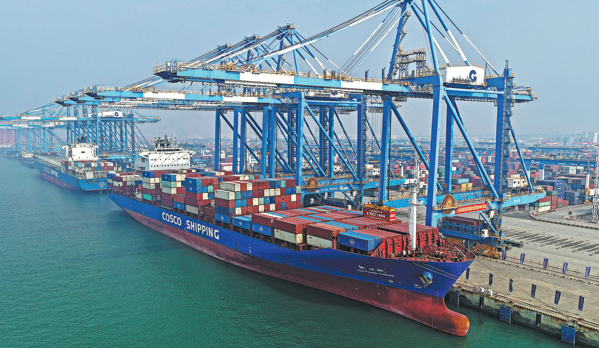
South China's Guangxi Zhuang autonomous region has largely fulfilled its goals in building the New International Land-Sea Trade Corridor, as the 10 millionth container was smoothly hoisted at Beibu Gulf Port in Qinzhou on Tuesday.
This milestone marks a significant step in solidifying the region's role as a key player in China's national trade strategy.
Bound for the Middle East, the container carried high-value-added exports, including automobiles and machinery equipment from China.
It is also set to bring back energy products and agricultural goods from the Middle East to the region, highlighting the corridor's growing importance in two-way trade.
Bai Songtao, director of the Development and Reform Commission of Guangxi Zhuang autonomous region, said Guangxi has fulfilled all major goals and tasks outlined in the Master Plan for the New International Land-Sea Trade Corridor on schedule.
The corridor so far has delivered a series of landmark and groundbreaking outcomes, further cementing its role as a vital trade artery.
The corridor serves as a crucial link connecting the Silk Road Economic Belt in the north and the 21st Century Maritime Silk Road in the south, effectively bridging China's vast western inland areas with ASEAN and global markets.
The corridor features a multimodal transport network integrating railways, sea routes, highways and air freight.
"The three planned major east, middle and west routes of the corridor — which connect western China to global markets via Guangxi's Beibu Gulf Port — are taking shape at an accelerated pace," said Bai.
Pinglu Canal, set to be completed and open to navigation next year, will provide the shortest, most cost-effective and convenient sea route for inland Guangxi as well as China's southwest and northwest regions.
At present, railway-sea intermodal trains of Beibu Gulf Port cover 18 provinces, 75 cities, and 163 stations in central and western China, with an annual dispatch volume topping 500,000 twenty-foot equivalent units — a 3.5-fold increase from 2019.
Cross-border trains between China and Vietnam via Pingxiang Railway Port have operated more than 2,900 services in total, with logistics volume maintaining rapid growth.
"Beibu Gulf Port now operates 100 container routes, linking more than 200 ports in over 100 countries and regions," Bai said.
Beibu Gulf Port, a cluster comprising Qinzhou Port, Fangchenggang Port and Beihai Port, is considered a key infrastructure project of the corridor.
Hu Huaping, chairman of Guangxi Beibu Gulf Port Group, said that in recent years, Guangxi has stepped up efforts to advance port infrastructure construction, completing a 300,000-ton oil terminal and a 200,000-ton automated container terminal in succession, while pushing forward a number of major projects, including a 300,000-ton bulk cargo terminal.
Currently, Beibu Gulf Port boasts an annual cargo handling capacity of 600 million tons and an annual container handling capacity of 11 million TEUs, said Hu.
On the same day, Beibu Gulf Port launched its 100th container route — a new service linking the port directly to Cambodia.
The container vessel sailed for Cambodia loaded with plywood, PVC and other goods to mark the route's inaugural voyage.
Also, the 10,218th railway-sea intermodal train of the New International Land-Sea Trade Corridor departed Qinzhou Railway Container Center Station, as Beibu Gulf Port's railway-sea intermodal container throughput topped 500,000 TEUs in 2025.



Today's Top News
- Confidence, resolve mark China's New Year outlook: China Daily editorial
- Key quotes from President Xi's 2026 New Year Address
- Full text: Chinese President Xi Jinping's 2026 New Year message
- Poll findings indicate Taiwan people's 'strong dissatisfaction' with DPP authorities
- Xi emphasizes strong start for 15th Five-Year Plan period
- PLA drills a stern warning to 'Taiwan independence' separatist forces, external interference: spokesperson