


China curbs dual-use item exports to Japan









China announced on Tuesday an immediate ban on exporting dual-use items to Japan, in response to Japanese Prime Minister Sanae Takaichi's erroneous remarks hinting at the possibility of military intervention in the Taiwan Strait.
These remarks "constitute gross interference in China's internal affairs, seriously violate the one-China principle, and are extremely egregious in both nature and impact", a spokesperson for the Ministry of Commerce said on Tuesday.
In order to safeguard national security and interests, as well as fulfill international nonproliferation obligations, China decided to strengthen control over dual-use item exports to Japan, the ministry said in its first announcement of the year.
Dual-use items refer to products, software and technologies that have legitimate civilian uses, but can also be adapted for military purposes, such as the development of weapons of mass destruction or the enhancement of conventional military capabilities. The list covers items from chemicals and drones to high-tech computers and software.
The country prohibits the export of all dual-use items to Japanese military users, for Japan's military use, and for any other end-users and end-use purposes that help enhance Japan's military capabilities, according to the announcement.
Stringent export controls and licensing requirements for dual-use items represent an established international norm.
The United States' Export Control Reform Act and the European Union's Dual-Use Regulation, for instance, mandate that the export of sensitive technologies or materials, including those with potential military applications, must be subject to proper licensing and authorization procedures.
China is also considering tightening export permit reviews for certain rare earth-related items to Japan, due to Takaichi's recent erroneous remarks on Taiwan and her continued refusal to retract them, a source familiar with the matter told China Daily on Tuesday.
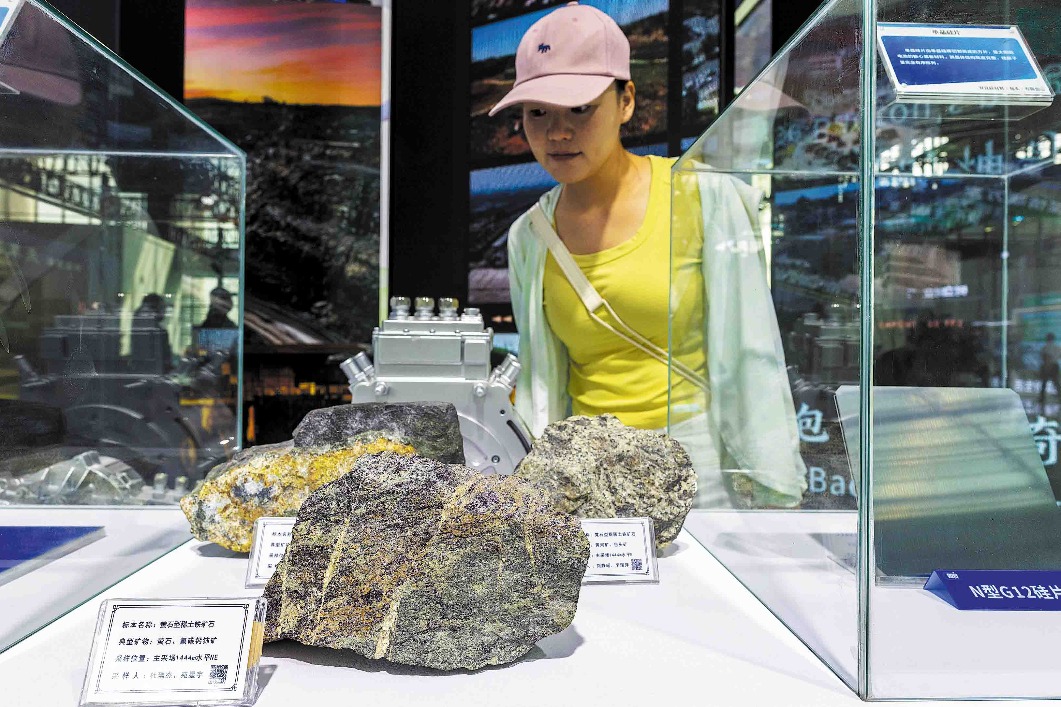
On April 4 last year, the Ministry of Commerce, along with the General Administration of Customs, issued an announcement on export control measures for seven categories of medium and heavy rare earth-related items — samarium, gadolinium, terbium, dysprosium, lutetium, scandium and yttrium.
According to Tokyo-headquartered Nomura Research Institute, heavy rare earths such as dysprosium and terbium, used for electric vehicle motors in Japan, are almost 100 percent sourced from China. Any restrictions on those supplies would pose significant challenges to the Japanese economy.
The institute estimates that if China's restrictions on rare earth exports to Japan were to last for three months, it would result in losses of about 660 billion yen ($4.2 billion), reducing nominal and real GDP by 0.11 percent annually. If the restrictions continued for a year, losses could reach about 2.6 trillion yen, leading to a 0.43 percent decline in both nominal and real GDP as noted by the institute.
Beijing has sent Tokyo a clear message that it cannot expect to continue benefiting from China's vast market and resources while challenging China's core interests, said Chen Wenling, former chief economist at the China Center for International Economic Exchanges.
"The one-China principle and noninterference in China's internal affairs form an unbreachable prerequisite for China-Japan cooperation,"Chen said.
Tetsuro Homma, executive vice-president of Panasonic, said that China is not only a consumer market or a manufacturing powerhouse, but also an innovation and engineering hub.
"For Japanese companies, strengthening collaboration with Chinese supply chain partners is crucial. It enables us to deliver quality products to global consumers at more competitive prices,"Homma said.