


Record trade bodes well globally
Trade:?Chinese market's potential highlighted










China's foreign trade is positioned for steady expansion this year despite mounting pressures, building on the strengths exhibited last year — a sustained shift up the value chain in exports, a broadening network of global partners and a supersized domestic market opening wider to imports, said officials and experts.
Beijing's push for balanced trade will continue to serve as a crucial stabilizing force for the country's economy, which is increasingly driven by domestic demand, while offering growing opportunities for global businesses in the year ahead, they added.
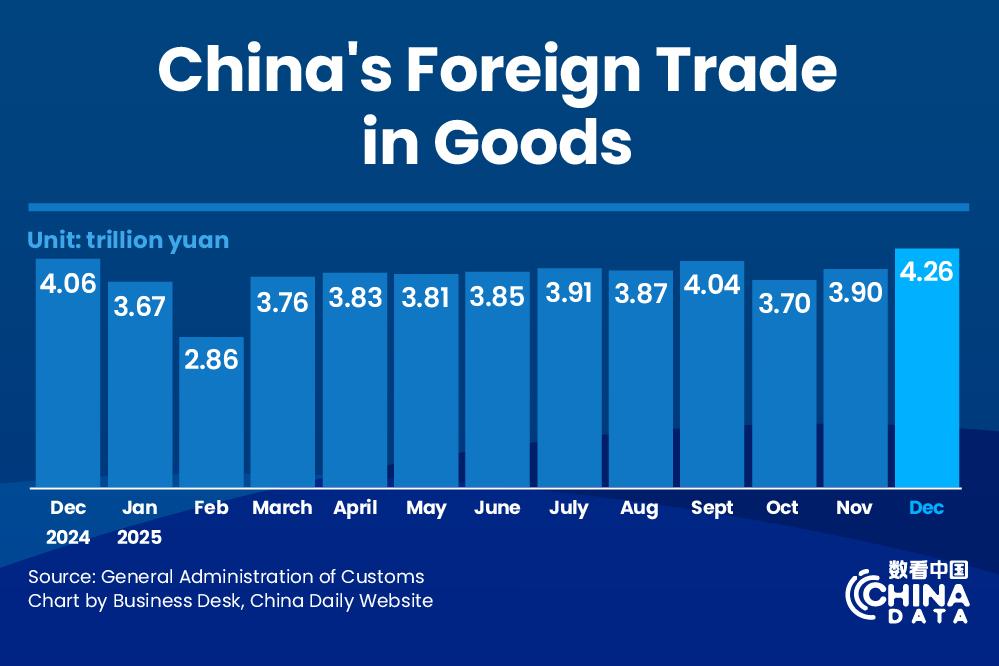
Their comments came after the General Administration of Customs said on Wednesday that China's total value of goods imports and exports hit a historic high of 45.47 trillion yuan ($6.5 trillion) in 2025, up 3.8 percent year-on-year.
"China has cemented its position as the world's largest trader in goods," said Wang Jun, deputy head of the administration, at a news conference.
Exports fueled last year's overall trade growth, rising 6.1 percent year-on-year to 26.99 trillion yuan. A notable highlight was the export of high-tech products, which surged 13.2 percent to 5.25 trillion yuan.
The "new trio" of green exports — electric vehicles, lithium-ion batteries and photovoltaic products — collectively rose 27.1 percent year-on-year. Wind turbine exports grew even more sharply, climbing 48.7 percent from the previous year.
"What the world seeks from China today is no longer defined by competitive pricing," said Wang Xuekun, head of the Chinese Academy of International Trade and Economic Cooperation. "It's increasingly about applied innovation, green transition solutions and supply chain resilience."
On the factory floors of Ningbo Jingwei Systemtechnik in Zhe-jiang province, internet of things-enabled cutting machines stand ready for markets worldwide, where they will help local textile manufacturers accelerate digital transformation.
"Dubbed the 'industrial tailor' by overseas clients, the equipment can improve production efficiency up to 300 percent while raising material utilization to over 90 percent," said Zheng Zhaoze, the company's deputy general manager, noting that the company now serves more than 30,000 clients worldwide.
Beyond product innovations, officials and experts pointed to an expanding "circle of friends" as a crucial factor for export resilience, even as certain economies have resorted to protectionist measures, including hefty tariffs against China.
Wang Jun, the senior customs official, noted that China's exports to economies involved in the Belt and Road Initiative grew 11.2 percent year-on-year, contributing 5.4 percentage points to overall export growth.
The Association of Southeast Asian Nations has remained China's largest export market for three consecutive years, while exports to emerging markets such as Latin America, the Middle East, Central Asia and Africa have all grown faster than the overall export average, he said.
Looking to 2026, policymakers at December's Central Economic Work Conference called for promoting high-quality Belt and Road cooperation, as well as negotiating and signing more regional trade and investment agreements.
Lu Ting, chief China economist at Nomura, said that China's export growth is expected to enter a phase of "modest uptick" over the next five years, with annual expansion projected to be between 2 percent and 4 percent, due to a significantly enlarged export base and mounting external pressures within the global trading landscape.
Experts and executives said that while strong exports remain a key driver for trade growth, there is growing consensus that scaling up imports and striving for balanced trade will not only fuel domestic consumption upgrades, but also benefit global businesses.
According to the General Administration of Customs, China's imports expanded 0.5 percent in 2025 from a year earlier to 18.48 trillion yuan, maintaining its share of global imports at around 10 percent.
Robert Koopman, former chief economist of the World Trade Organization, said that over the next five to 10 years, "an important evolution in China's role is going to be to shift toward being a big center of demand".
For the world's second-largest importer, pursuing the balanced development of imports and exports has been a long-term strategy. It has been included in the recommendations of China's top leadership for formulating the country's 15th Five-Year Plan (2026-30).
The Ministry of Commerce launched the "Big Market for All: Export to China" initiative in November to motivate foreign businesses to increase their exports.
"In today's global economy, a reliable and growing market is perhaps the rarest resource," said Liao Fan, director of the Chinese Academy of Social Sciences' Institute of World Economics and Politics.
With a population of over 1.4 billion, including over 400 million middle-income consumers, China represents an annual consumer market of about 50 trillion yuan. By actively expanding imports, it is turning vast domestic purchasing power into a shared global marketplace and creating massive opportunities for foreign enterprises, Liao added.
Hubert de Haan, senior vice-president for China at German home appliances company BSH, said, "The Chinese market's sheer scale and diversity, from top-tier cities to lower-tier cities that are also growing in wealth, present vast, untapped potential."
"Chinese consumers are eager to try new things and have high demand for innovation," he added. "With the competencies and capabilities that we gain here, we can also win in other parts of the world."