

Innovative architecture gives rise to schools of the future
Creative thinking solves conundrum of limited space, urgent need for student places










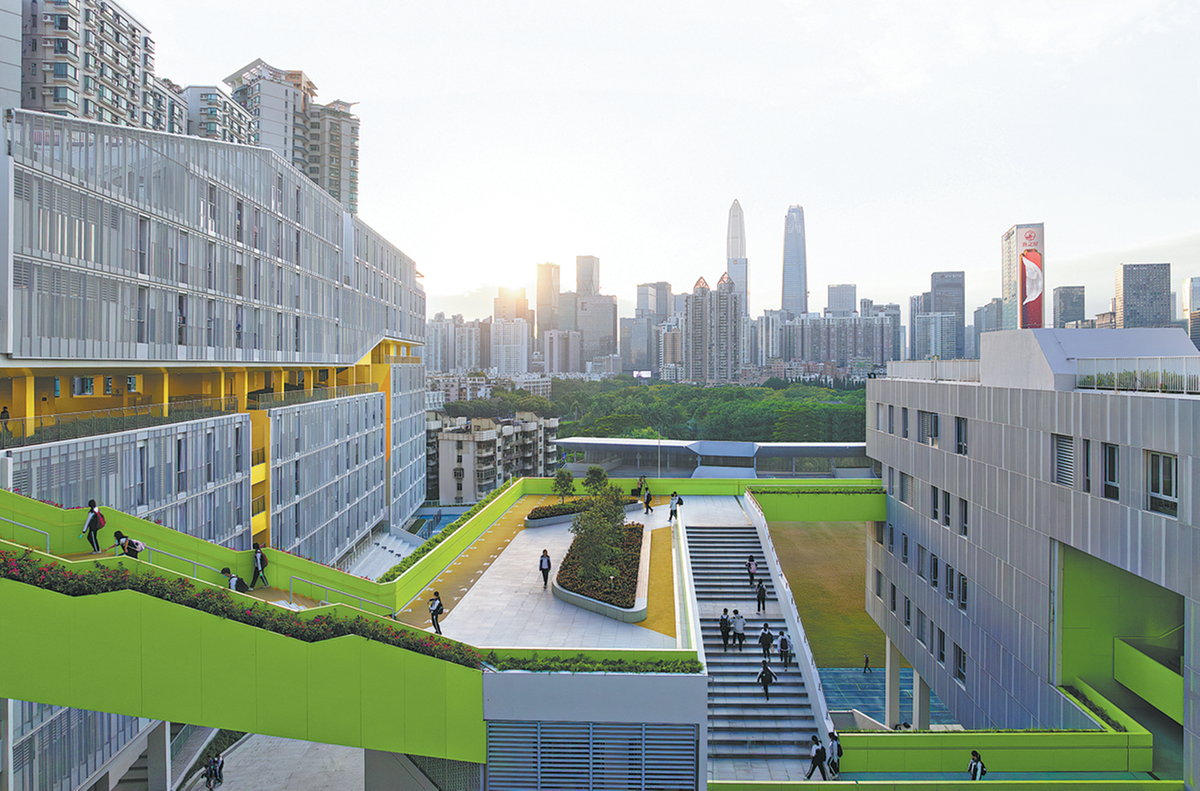
Six years after completion of the Hongling Experimental Primary School in Guangdong province, architect He Jianxiang still finds himself drawn back to the school.
Sometimes, he brings international architecture peers, other times educational delegations, to the futuristic school at the foot of Antuo Hill in Shenzhen.
And without fail, as the school day ends, he witnesses the same scene — children racing across the semi-underground indoor basketball court, examining crops in the rooftop garden, chasing through corridors of seemingly impossible width and playing in the sunken, landscaped courtyards.
All are evidently in no hurry to go home, and their laughter fills the space.
"This is the most fulfilling feedback I could ever receive," said He, the lead architect behind the school, which was feted as the first to crack the local puzzle of a high-density school in a city, with a population comparable to Beijing's, yet with a land area only one-eighth the size.
Completed in 2018, Hongling school in Futian district was the earliest and most influential project to emerge from Shenzhen's "new campus action plan".
The plan was driven by a city in a building crisis and in particular, a desperate shortage of student places.
In 2017, local authorities launched a five-year plan with a total investment of 400 billion yuan ($56.3 billion) that outlined the construction of 247 new schools in Shenzhen, aiming to add 740,000 new student places.