



Nation calls for cooperation and free trade









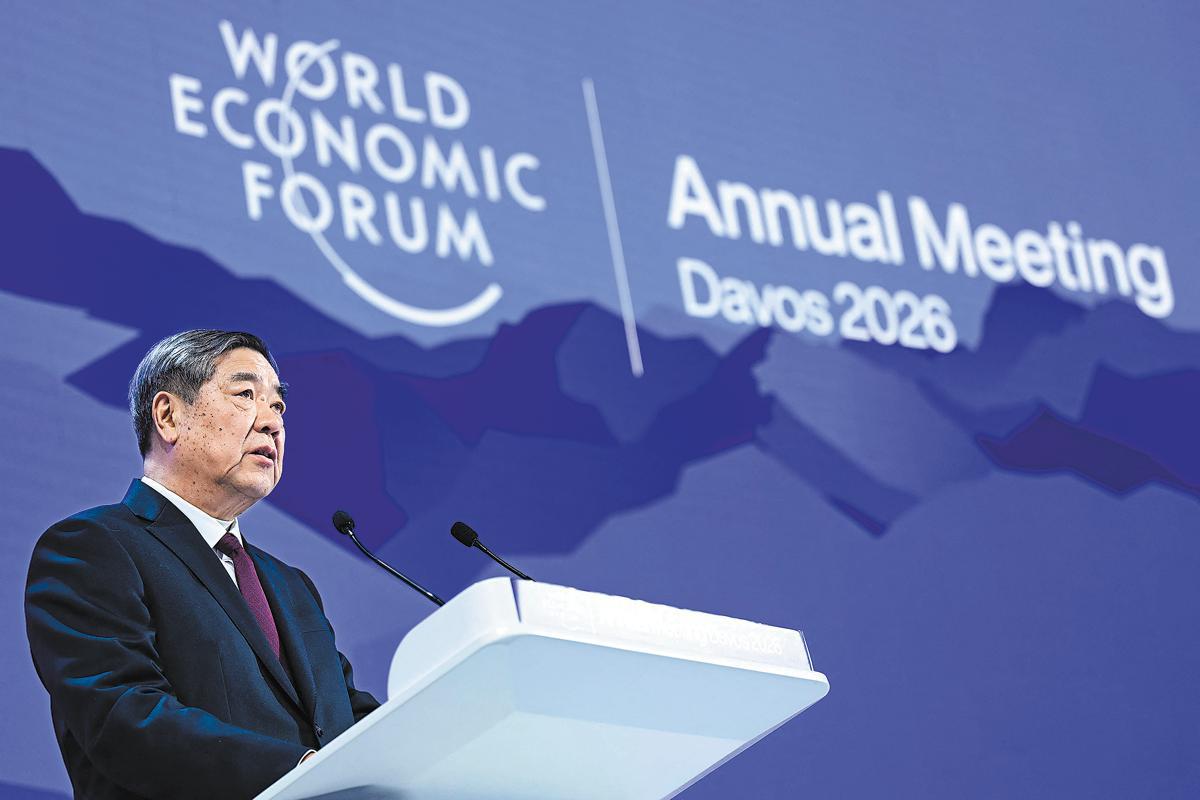
China delivered a strong message of advocating free trade, multilateralism and cooperation on Tuesday at the ongoing World Economic Forum annual meeting in Davos, Switzerland, as Vice-Premier He Lifeng called for dialogue and joint problem-solving amid rising geopolitical tensions and economic rifts.
Speaking at the Davos Congress Hall, He urged countries to focus on expanding shared opportunities rather than competing over limited gains, saying that solving problems together is more effective rather than blaming each other.
He emphasized that although economic globalization has shortcomings, it should not be totally rejected, and warned that tariffs and trade wars have no winners.
"Everyone should be equal before the rules. A very small number of countries should not enjoy the privilege of pursuing their own selfish interests. The world must not return to the law of the jungle, where the strong prey on the weak," he said, calling on the international community to uphold multilateralism and resolve disputes through dialogue.
The vice-premier said that China is committed to fostering common prosperity with its trading partners through its own development and by contributing to global growth.
China has never deliberately pursued trade surplus, he said, adding that the country aims to not only be the "world's factory" but also the "world's market", expanding imports and opening wider to global products and services.
He noted that services now account for about two-thirds of glo-bal GDP, and that China has long run a deficit in services trade, reflecting growing demand for overseas services such as travel and education.
The vice-premier also emphasized that differences among countries with diverse social systems, development stages and cultures are normal, and should be addressed through mutual respect, equal-footed consultation and trust-building through dialogue, rather than confrontation or antagonism.
On China-United States relations, He said that although economic and trade ties have experienced fluctuations, dialogue has helped maintain overall stability. The experience, he said, shows that China and the US both benefit from cooperation and lose from confrontation, and that equal consultation and working in the same direction can lead to more solutions than problems.
He highlighted China's steady economic performance in recent years, noting that over the past five years, the nation's economy has grown at an average annual rate of about 5.4 percent, expanding to around 140 trillion yuan ($20.1 trillion) and contributing roughly 30 percent to annual global economic growth.
The vice-premier attributed the nation's growth primarily to reform, opening-up and innovation, rather than so-called government subsidies. The Chinese economy is built on solid foundations, with strong resilience and significant long-term potential, supported by continued market opening and the development of new quality productive forces, he added.
Borge Brende, president and CEO of the World Economic Forum, praised the Chinese vice-premier's remark that the wisdom of Davos lies in dialogue.
In the 1980s, China accounted for 2 percent of global GDP and today, that figure is close to 20 percent, "so it is a very important path that China is following", Brende added.
David Haigh, founder of Brand Finance, a London-based brand valuation consultancy, said, "China is a counterbalance to the chaos that is being caused (by) America."
Haigh underscored that free trade, multilateralism, and respect for international organizations and the rule of law are essential to have a properly working world economy. It is "extremely good" for China to advocate those values, which "shows that China is leading when it comes to soft power and sensible governance", he said.
Dora Liu, CEO of Deloitte China, said that Vice-Premier He's speech highlighted the importance of dialogue and win-win cooperation at a time of rising protectionism, noting that China's overseas investment has generated more than $300 billion in tax revenue for host countries over the past five years.




















