


Her perspective powers innovation
From AR storytelling to AI health tools, women developers designed technology rooted in empathy, lived experience, and social needs.









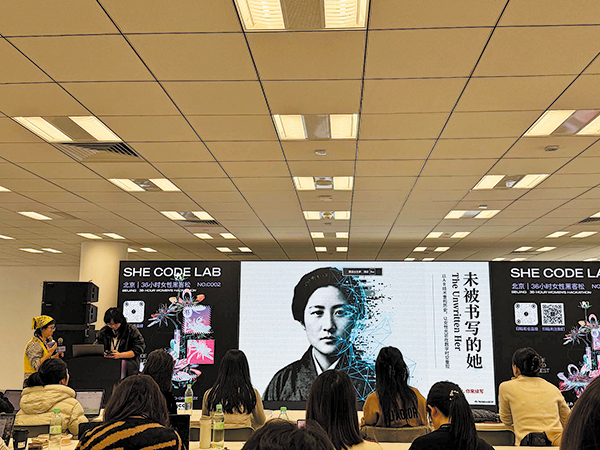
At 1 am on Jan 17, Wang Wanchen, a mechanical engineering student, and her two teammates, Huang Xuwei and Li Ziqi, were still deep in discussion, refining the prototype of an app they had been building. They called it "The Unwritten Her" — an immersive AR experience designed to bring the long-buried stories of real women back to life at historical sites.
Despite their fatigue, their eyes shone with excitement and determination. "With an all-female team, we can work day and night together," Wang said. "It feels very pure, and the atmosphere is warm and supportive."
Wang and her teammates were among more than 100 participants at the She Code Lab 36-Hour Women's Hackathon, held in Beijing from Jan 16 to 18. Over the course of 36 hours, they formed teams, brainstorming, designing, coding, and ultimately delivering functional product prototypes under tight time constraints.
While female-focused, the event welcomed participants of all genders. Still, women led the work and set the tone. Organized by She Nicest and Coding Witch, the event emphasized "technology for good" and promoted a women-friendly value system. With the theme "Her Perspective", its mission was captured in the slogan:"Women Hack the Future Together. The Future is Something We Code Together".
The results reflected a wide range of concerns and creativity. Apart from "The Unwritten Her", one team developed an app to help users navigate the emotions of saying goodbye — to loved ones, pets, or cherished belongings. Another created an AI health companion designed specifically for women living with polycystic ovary syndrome, a common hormonal condition.
Events like this are urgently needed, participants said, because the tech world has long been male-dominated. Wang described feeling isolated in her daily study and work environments. From university classrooms to internships, being one of the few women often meant being overlooked.
"If there were more women in the tech industry, maybe one day we could discuss technology at a nail salon — not just in smoking areas," she said."Right now, so many industries are led by men, so things naturally cater to their preferences."
Peng Jing, one of the organizers, believes the smaller presence of women in tech has little to do with ability and far more to do with expectations."Even when women have strong skills and leadership potential, they're often not encouraged to take charge. When people don't expect a woman to lead, she may be less likely to pursue leadership roles herself," she said.
Another organizer, Song Yuhang, examined the issue from a broader structural perspective: "If new productive forces are dominated by only one gender, it will lead to greater inequality in the future, excluding women from having a say in decision-making and access to wealth distribution," she said.