



Ancient academies still influence modern education









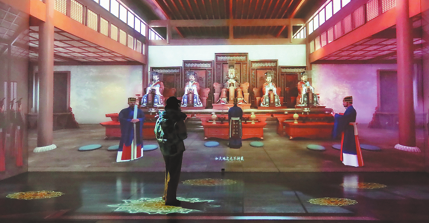
Amid the aroma wafting from book pages, the exhibition hall in the National Library of China in Beijing evokes a sense of the chanting sounds that worship Confucian sage wisdom in ancient classics throughout Chinese history.
From the Tang Dynasty (618-907) to the end of the Qing Dynasty (1644-1911), classical academies, known in Chinese as shuyuan, functioned as key educational venues for lectures, collecting, and book publishing, as well as ceremonial sites for scholars' self-cultivation.
More than 110 ancient books and other documents are on display in the Xiuxue Haogu, Shishi Qiushi: Shuyuan in Ancient Classics exhibition, which opened on Monday at the National Library. The exhibition traces the path by which these academies have sustained Chinese civilization's lasting lineage.
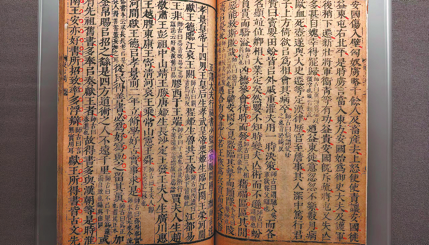
The theme of the exhibition, xiuxue haogu, shishi qiushi, or "be diligent in learning and reverent toward antiquity and seek truth from facts", is an excerpt from the Book of Han, written in the first century. Consciously or subconsciously, generations of traditional Chinese literati may have used this motto as a guiding principle.
A 1642 print edition of this book is also on display, with the page on which this line is written highlighted.
"Over more than 1,000 years of development, shuyuan have played a significant role in talent cultivation, academic innovation, the spread of Confucianism, and cultural inheritance," says Wei Chong, deputy director of the National Library. "Through this exhibition, we want to bring their legacies back to contemporary life."
According to Wei, over 7,500 shuyuan academies were established across China during the Tang and Qing dynasties. Though their heyday is far behind them, some traditional academies have continued to thrive. Yuelu Shuyuan in Changsha, Hunan province, is one example. This institute was the foundation of today's Hunan University.
Among the key exhibits is Duice (countermeasure), a Tang Dynasty handwritten scroll found in the Mogao Caves in Dunhuang, Gansu province, which served as a reference book for scholars to prepare for exams. A series of rare books from the Song (960-1279) and Yuan (1271-1368) dynasties also remains key witnesses to the development of shuyuan.
During the Southern Song period (1127-1279), in particular, the boom in shuyuan coincided with the rise of a philosophical school known as Neo-Confucianism.
Both governments and the private sectors were involved in establishing this system of academies, enabling education to serve society, explains Deng Hongbo, a professor at the Yuelu Shuyuan of Hunan University.
"Shuyuan thus contributed to shaping how Chinese people think and our morals and ethics," Deng adds.
From the Ming Dynasty (1368-1644) on, shuyuan also deeply influenced neighboring regions, including the Korean Peninsula, Japan, and Southeast Asia.
To trace the origins of shuyuan culture, the exhibition curators naturally expanded the time span and perspective of its evolution to a broader perspective of literary history.
An inscribed oracle bone from the Shang Dynasty (c.16th to 11th century BC) documented an emphasis on education. Oracle bone inscriptions are the earliest-known established form of the Chinese writing system.
Time has taken its toll on the Xiping Stone Classics, the official Confucian classics carved on stones during the Eastern Han Dynasty (25-220). However, a broken piece on which some words from Confucius' The Analects were carved, may have demonstrated how the strength of education overcame the erosion of time.
From the mid-19th century, the ailing Qing Dynasty began facing a deep social crisis due to the impact of the dominant Western powers. The reform of the traditional education system seemed urgent. In 1901, following the emperor's edict, traditional shuyuan gradually turned into modern schools.
"Nevertheless, their values still shine today when people search for references in innovation," Deng says.
The motto "to seek truth from facts" once hung in the Yuelu Shuyuan to encourage knowledge-thirsty students. Today, it is a key principle of China's national governance, guiding the country's continued reform and opening-up.
"Our modern mindsets are connected to shuyuan legacies," Wei says. "Key elements of ancient wisdom have always been enriched with the flow of time."






Today's Top News
- Xi congratulates Yoweri Museveni on re-election as president of Uganda
- Senior military officials under investigation: Defense Ministry
- Systematic approach sees return of clear waters to the Yangtze River
- IP protection for new fields to improve
- Draft rules define premade dishes in consumer interest
- Xi greets To Lam on election as Vietnam party leader