



Sharing memories boosts conservation
Rich with history, educators in a village help pass down heritage protection to younger generations, report Liu Boqian and Yang Jun in Guizhou.









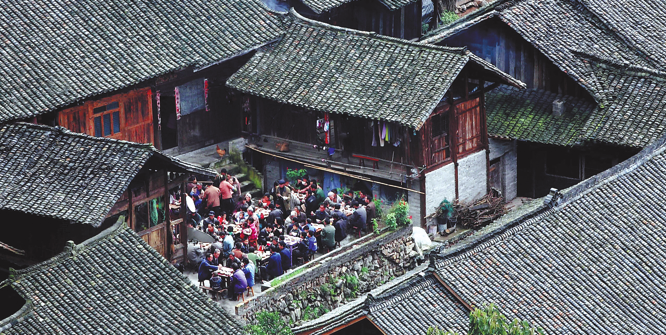
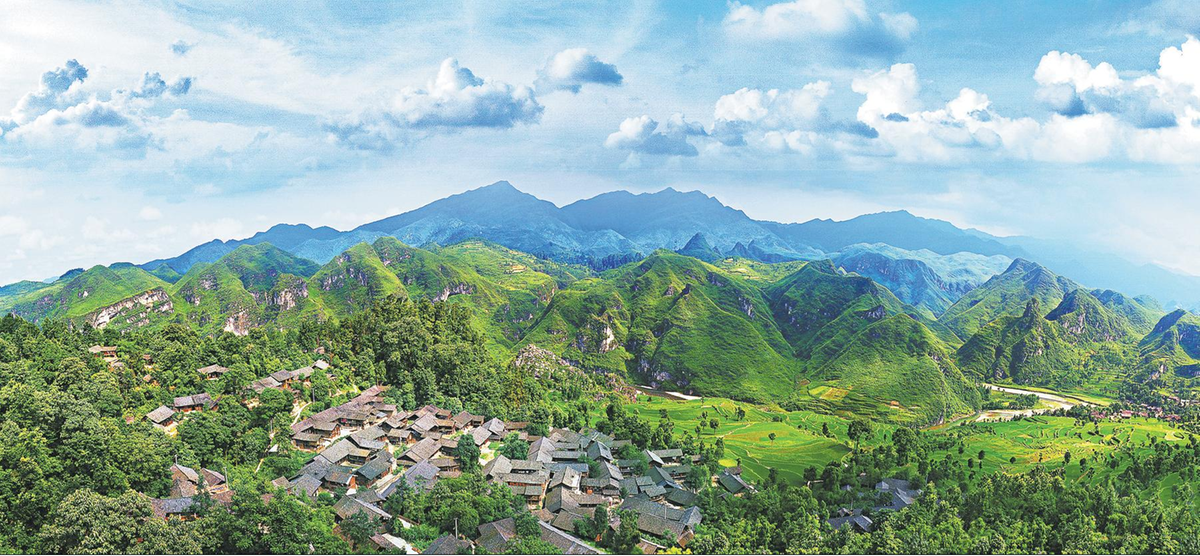
When Du Xiaofan from Fudan University first visited Loushang, an ancient village in Guizhou province, in 2015, he was captivated by its scenic beauty and relatively intact architecture preserved over centuries.
Framed by mountains and a river, the village is a textbook example of feng shui, shorthand for traditional principles of settlement geography.
Loushang, home to roughly 1,600 residents who mainly grow corn and rapeseed, sits in Guorong township, Tongren city, and retains an architectural ensemble dating from the Ming (1368-1644) and Qing (1644-1911) dynasties. Temples, ancestral halls, an opera stage, and a traditional academy remain among its historic structures, which were listed as the national key cultural relics protection unit in 2013.
Du, a professor in the Department of Cultural Heritage and Museology, together with a team of more than a dozen Fudan University researchers from various fields, including cultural heritage, architecture, planning, and landscape, spent two months in 2016 conducting surveys and fieldwork to draft a conservation plan.
Du believes that protecting rural heritage should focus on preserving a unique lifestyle and set of values to prevent the erosion of cultural diversity.
"We gradually adopted the idea of living conservation," says Hou Shi, an associate professor at Fudan. "We started with buildings, and then conducted systematic surveys of village history, landscapes and surrounding plants, inviting residents to use classrooms, have festivals, and create memories to pass on traditions to younger generations."
Residents, particularly students, have been deeply involved over the past decade. For Du, young people are the inheritors and transmitters of culture. Yet, should they fail to identify with their native history, traditional skills, and village landscape, the heritage risks becoming a mere static exhibit.
Memories matter. Children in the village now talk about its buildings and folk culture as readily as they do school lessons. For them, the shared memories of family and place are part of daily life.
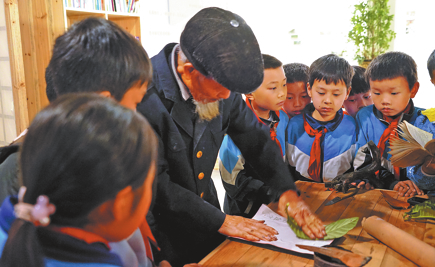
"Our teacher Quan taught us the difference between tangible and intangible cultural heritage. She took us to every corner of the village and told us to ask our grandparents for stories about the village," says 13-year-old Zhou Ziyu.
Quan Yixian, who holds a doctorate in cultural heritage and museology from Fudan, and several other members of the university have been teaching heritage classes in the township's primary school in Loushang for many years.
The program meets twice a week for different age groups and gives each student a chance to participate.
The lessons, which started in 2022, combine on-site instruction about village relics, visits from intangible heritage bearers, and training for students to serve as junior guides.
"My grandmother said that when she was a child, she went to opera performances. Because she was short, she kept stepping back until she stood in a puddle and soaked her trousers," says 12-year-old Zhou Tingjiayi. The stage she described, now a playground for kids, was built in 1916, according to records, and performances are still held on holidays and during festivals.
The curriculum stresses village wisdom as much as relics. Teachers have revived the shuochun tradition, a singing and spoken form once used to announce seasonal work, urging people to plow and offer blessings for good weather and harvests.
Zhou Zhengbing, the only remaining master of shuochun in Loushang, performs excerpts for students and leads discussions on the agricultural calendar, local geography and blessing rituals embedded in the songs. Children who have never seen or heard the tradition ask inquisitive questions.
"This system embodies a rational use of seasonal rhythms and respect for nature," Quan says, stressing that passing on local wisdom matters more than rote learning.
Some students discovered that their own family elders had participated in construction of the ancient buildings. In contrast, others became fascinated by UNESCO World Heritage sites introduced in class.
Some family memories find unexpected ways to live on through the classroom. Zhou Yuanhang, now a junior high student studying outside the village, learned in a heritage class that his ancestors helped renovate the village's theatrical stage.
When he returned home and asked relatives, he discovered that his family was a well-known carpentry clan in the village. As a descendant of that clan, he expressed a fascination with architectural model-making.
Liu Shaoyuan, a researcher from Fudan, says the work highlighted a key insight: villagers are both the creators and the empathetic interpreters of heritage.
"Heritage protection must be embedded in cultural traditions and memories, and must evolve into modern life to meet people's cultural and spiritual needs," Liu says.
In 2023, a UNESCO Chair on Living Heritage and Community Development established a base in Loushang. Hosted by Fudan University, it has since launched village workshops, set up the Loushang heritage classroom, and built systems for collecting oral histories, training in heritage protection, and youth education.
While Fudan scholars brought academic resources to the village, local educators and cultural figures have sustained the same values through grassroots efforts.
Zhou Zhengwen, a retired art professor of Tongren University, returned to Loushang in 2015 to help establish the Yangzheng Academy, an institution providing training and cultural classes. He offers free after-school calligraphy, painting and, more recently, guqin lessons.
"It is less an extracurricular class than the subtle influence of dedicated teachers," says Zhou Qihong, the former head of the primary school who helps run the academy.
"The village motto is 'I do not wish my descendants official posts. I only wish them virtue'. The cultivation of scholarship is Loushang's greatest treasure," Zhou Zhengwen says.
He hopes the academy provides a place for left-behind children or those with only one parent at home, away from digital distractions. With donations, the academy has persisted for 10 years and sometimes attracts outside students who stay after a single class.
"Fudan's teachers have helped with scholarship and also by lighting children's imaginations," Zhou Zhengwen says. "Many want to be like them when they grow up and begin planning their futures."
Over the past decade, more children from the academy have gone on to school such as the China Academy of Art. Each year, seven to eight former students return to serve as volunteer teachers, thus passing the torch.
Loushang's approach echoes a broader turn in China's countryside, where shrinking rural populations and the departure of younger generations increasingly affect heritage preservation.
Rural depopulation has reduced the local primary school's roll call, as many families have moved to nearby towns and now return only for festivals. Deng Wenming, the primary school principal, says the Loushang school now has about 80 students, and that number is likely to fall.
Hou, the scholar from Fudan, says he found similar situations in provinces such as Yunnan and Fujian. "This has prompted our efforts to connect cultural transmission with local schooling, shifting attention away from buildings toward practices and memories sustained by remaining communities," Hou adds.
Sustaining Loushang, however, depends on economic opportunity. Local officials say the village does not charge an entrance fee and hosted about 30,000 visitors through group tours in 2025. While significant, this number is relatively low for a tourism village.
Developing tourism and related industries while preserving the village's original character remains unresolved.
"We want to protect Loushang's historic appearance. That is its greatest asset. We hope to use Fudan's connections to attract academic engagement and make it a site for study programs and link it to nearby attractions," says Liu Zhonghua, Party secretary of Guorong township.
Liu Zhonghua emphasizes that development must fit local conditions. "Loushang has accumulated deep academic resources. We can't simply build a commercial street like other ancient towns; we need an overall plan," he says.
He adds that future development must encourage visitors to do more than look at houses and trees. It should foster recognition of Loushang's spirit — its traditions of scholarship and farming — and create cultural resonance between visitors and residents.






Today's Top News
- Xi congratulates Yoweri Museveni on re-election as president of Uganda
- Senior military officials under investigation: Defense Ministry
- Systematic approach sees return of clear waters to the Yangtze River
- IP protection for new fields to improve
- Draft rules define premade dishes in consumer interest
- Xi greets To Lam on election as Vietnam party leader