



Traditional Chinese medicine transforms into trendy beverages









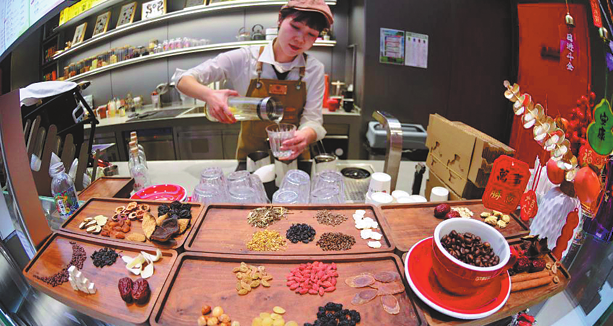
CHENGDU — For generations, traditional Chinese medicine arrived with ceremony as dried roots and peels carefully measured from wooden drawers, taken home, and simmered in a slow, bitter ritual that demanded attention when the body called for care.
Today, it can be ordered iced and sipped while commuting.
On the iconic Chunxi Road, a century-old commercial area in Chengdu, Southwest China's Sichuan province, a cup of coffee is rewriting expectations. "At first sip, it tastes like coffee," says Shazia, a Pakistani student studying in China. "But the finishing note holds a hint of lemon, light and refreshing."
The drink is a dried tangerine peel and hawthorn Americano from Tong Ren Tang (Beijing TRT Group), a venerable TCM pharmacy with a heritage spanning over 350 years.
For foreigners, the encounter can be puzzling. Why are coffee, bread and new-style tea drinks in China increasingly infused with medicinal herbs? The answer reflects not a simple revival of traditional remedies, but a broader reordering of health, anxiety and everyday consumption.
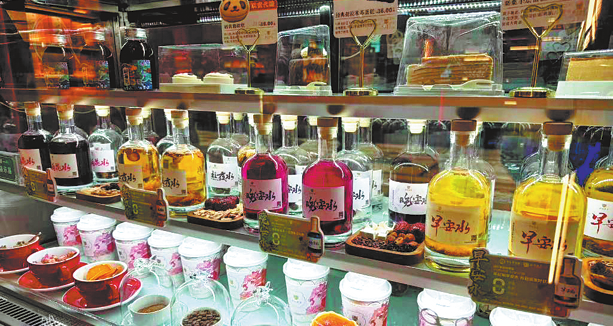
Tong Ren Tang's foray into lifestyle retail is emblematic. Founded in 1669, it has been associated with orthodox medicine since the Qing Dynasty (1644-1911) and has expanded into lifestyle-oriented formats in recent years. Through its youth-oriented sub-brand, Zhima Health, it now sells coffee, tea drinks, baked goods, and bottled "wellness waters", weaving familiar herbal ingredients into consumption settings young consumers already frequent.
The menu sounds more culinary than clinical, with offerings such as a goji berry latte, a monk fruit Americano and a cinnamon cappuccino. These are not prescription drugs. In Chinese tradition, they belong to what is known as the "medicinal and edible homology" system, in which ingredients commonly used in cooking provide mild nourishment, aid digestion, reduce sugar intake, and help balance taste.
Store design does much of the work. Visual cues from traditional pharmacies remain, but the atmosphere is contemporary and tailored for social media. Medicine no longer arrives through bitterness and patience, but through taste and convenience. The contrast of centuries-old ingredients served in a coffee cup softens psychological resistance. "It's not what I imagined Chinese medicine would be," Shazia says. "It's more like a new flavor."
Among young Chinese consumers, the appeal is less about therapeutic certainty than a sense of reassurance. He Yue, a 34-year-old programmer, says he does not dwell on whether such herbal-infused drinks have measurable effects.
"It's like keeping good health in a punk way," he says, referring to a self-styled approach in which young people, under pressure and time constraints, borrow the language of health to make minor, personalized adjustments to daily life. "At least it feels like I'm extending my life."
"Extending life" functions less as a medical claim than as emotional shorthand. Tong Ren Tang has described this cohort as a self-aware young generation that oscillates between unhealthy habits and small acts of self-repair, seeking balance not through discipline, but through everyday, low-effort rituals. In this sense, the product is the ritual.
What began in cafes has broadened. Herbal ingredients are first softened into coffee and tea drinks, then folded into baked goods. The Chengdu Second People's Hospital has, somewhat unexpectedly, become a destination for medicinal bread. On Chinese social media, posts documenting long queues have multiplied. Hospital staff say about 70 pieces are baked each morning and another 100 to 200 in the afternoon, most of which sell out.
Along one hospital corridor, freestanding signs read like menus and prescriptions at the same time. Names fuse nutrition with suggestion, such as Five-Black Grains Vitality Bread, Five-Honey Spleen-Nourishing Bread, and Orange Peel and Hawthorn Digestive Bread. Each costs 12 yuan ($1.72).
The familiar phrase "medicinal and edible homology" also appears on the signs, referring to an official government catalog that specifies which traditional medicinal materials may be used as food ingredients. First issued in 2002, the list has since been expanded in several rounds and now covers more than 100 approved substances.
The bread is designed to address modern anxieties such as late nights, sedentary work, a takeaway-heavy diet, and digestive discomfort. Consumers appear under no illusion. Online, some joke about "hiding Chinese medicine inside bread". Others describe it as the cheapest way to "extend life". Few press the question of efficacy. The hospital's involvement, it seems, provides enough reassurance.
The exact emotional arithmetic underpins the boom in so-called "life-extending water". In Beijing's office areas, herbal tea shops often see their busiest hours in the evening. Orders are placed fluently as "late-night water", "sleep water" or "ginseng water". The language borrows from internet slang, recasting exhaustion as something to be eased rather than solved through consumption.
Herbal and functional drinks have gained traction in Western markets as well. The turmeric latte, for instance, and coffees or beverages infused with ingredients such as ginseng or ganoderma lucidum (lingzhi) have become increasingly common in Europe and North America, often circulating alongside lifestyle settings like yoga studios and meditation classes.
In recent years, some international food and beverage brands have begun incorporating herbal or functional components, marketing them as part of everyday wellness routines rather than treatments.
According to a 2024 iiMedia Research report, China's wellness tea beverage market reached 41.16 billion yuan in 2023 and is projected to exceed 100 billion yuan by 2028. More than 20 brands are positioned explicitly around TCM and wellness. Compared with the fiercely competitive bubble tea sector, the niche offers the prospect of higher margins. Price, rather than dampening demand, often reinforces the message. Health, the logic implies, is not meant to be cheap.
TCM practitioners are careful to draw clear boundaries. Drinks and baked goods containing medicinal ingredients are positioned as food, not therapy. According to analysts, many of these products function more as expressions of lifestyle identity than as health interventions.
However, effectiveness is not the point. From a consumption perspective, what matters less is whether these products deliver measurable results than how they fit into daily life. In a highly intense economy shaped by long hours, late nights and constant self-management, health is increasingly understood as something incremental and sustainable. Caring for the body is no longer deferred until illness but woven into everyday choices, such as what to drink on the commute and what to eat for breakfast.
In that sense, rather than returning as an authority, herbal medicine has re-emerged as a lighter, everyday companion to modern life. No longer confined to prescriptions taken in times of sickness, it now appears in coffee cups, bread baskets and takeaway drinks, offering a way for people to renegotiate their relationship with health amid the pressures of fast-paced lifestyles.
Xinhua





Today's Top News
- Xi congratulates Yoweri Museveni on re-election as president of Uganda
- Senior military officials under investigation: Defense Ministry
- Systematic approach sees return of clear waters to the Yangtze River
- IP protection for new fields to improve
- Draft rules define premade dishes in consumer interest
- Xi greets To Lam on election as Vietnam party leader