



AI music tools have songwriters grooving
Applications are adding programs that help ordinary people and artists alike create coherent and structurally sound tunes









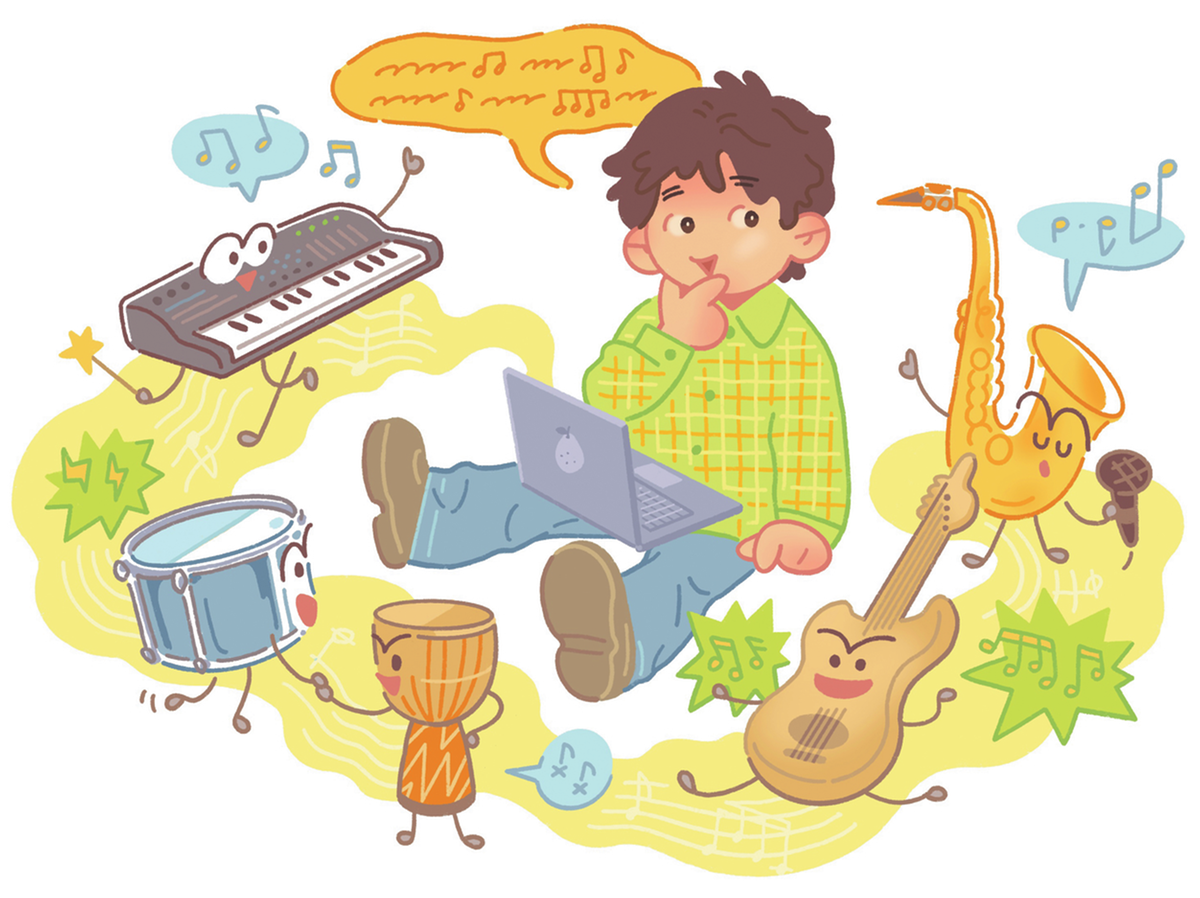
On a winter evening in Liaoning province, Lu Jun opens China's streaming app QQ Music, types in a few lines, and waits. Seconds later, a finished track is generated, including song lyrics that adhere to both melody and rhyme, and compositions that are coherent and structurally consistent.
He plays the song for his wife, Pang Huan, who is battling ALS (Amyotrophic Lateral Sclerosis).
Lu began using the AI songwriting tool in 2024 to document their love story and encourage his wife to stay strong. To date, he has created more than 700 songs with the assistance of artificial intelligence.
Lu works at the Benxi Freight Center of the Shenyang Railway Bureau and has always had a great love for music.
"I had written many lyrics in the past. One day, I input my lyrics into the AI songwriting tool on QQ Music to produce a song. My wife and I loved it so much that I've been composing with AI ever since," says Lu. "I've also tried generating a song in English by typing a one-sentence prompt without any lyrics. The resulting track, Only Love for You, had lyrics that carried a more artistic conception than the Chinese lyrics I wrote."
Lu Jun is not the only music lover who uses AI songwriting tools. Xia Gen, a 24-year-old who majored in musicology, is also fascinated by AI-composed songs.
With growing interest in AI, Xia tried the music-creation platform Suno in 2023 and tested the AI songwriting tools built into Chinese streaming apps, including QQ Music and Kugou Music, after their official launch. "In most cases, I use these tools to produce popular music", he explains.
Xia has long been an enthusiastic songwriter. Working life, however, has made it harder for him to continue writing.
"Long hours and the daily grind don't just eat into my composing time; they leave me in a creativity slump," he says. AI speeds up the rough-draft stage and brings up melodic ideas he can develop. He then rewrites the lyrics and reshapes the arrangement until the song satisfies him.
As a heavy user of AI songwriting tools, Xia is now a verified musician on QQ Music, where he posts a mix of original songs and tracks with AI's assistance.
Lu and Xia are among the growing number of people starting their music production journey with AI songwriting tools. Artificial intelligence, with its rapid advancement and diverse applications, is making its way into the daily lives of ordinary people. In response, Chinese music streaming apps have taken concrete steps by embedding AI songwriting tools directly into their apps to meet user demand.
"We launched our AI-powered tool in June 2024. Our brand-new AI songwriting app VEMUS is in the internal testing stage", says Zhao Chen, the supervisor of QQ Music's AI songwriting tool.
"Users now have access to create a song from a simple sentence, a set of lyrics, a hummed melody, or an image. For every prompt, our AI produces two different versions for the user to choose from. The chosen track can be further refined, along with the option to release it on our platform."
According to Zhao, AI assistance puts the power of music creation within everyone's reach, making it adaptable to a wide range of scenarios. So far, the AI songwriting tool has seen significant daily user engagement.
"Since our AI songwriting tool's debut, we've seen users celebrate their idols' birthdays with their own self-generated songs, while others express gratitude to teachers through personalized compositions on Teachers' Day. In one notable case, a user composed and played a melody as a wedding gift for his wife."
This platform strategy of turning listeners into creators aligns with Mikey Shulman's vision as the cofounder and CEO of the leading AI music company, Suno. Speaking on The Twenty Minute VC, a venture-capital podcast, in 2025, Shulman outlined his vision for music in the age of AI, saying that AI-generated music is an opportunity to drive greater engagement for both listeners and creators. He added that most artists he speaks with "use and love Suno", which he takes as an encouraging sign.
"I am extremely optimistic about the future," he said, suggesting that artists may eventually embrace AI tools.
Li Yanbing, a composer who graduated from the China Conservatory of Music, describes the AI music industry development as "a trend beyond imagination". In her opinion, AI shows great potential in productivity and creativity. It may soon take over parts of the workflow, such as background music.
However, for music professionals, especially younger ones, using AI as a tool is wiser than dismissing it.
"Those who learn to use it well, and then go beyond what it can do, can build stronger skills and keep pace with where the industry is heading," she says.
For Greyson Chance, an American singer-songwriter who toured China, the rise of AI inspires optimism rather than concern.
"I am not worried about it at all. Since the beginning of time, people have been singing and performing — that's not going to change because of technology. If anything, artists and musicians should use technology to improve their music. Sometimes I use AI software for inspiration."
AI songwriting is still in its early phase, but it has already changed the rhythm of how people make music.
Whether it ultimately enriches the musical landscape or leads to creative saturation will depend on how people use AI songwriting tools and on the industry's decisions about what is considered work and who gets recognition.
Lin Ke'er contributed to this story.






Today's Top News
- Xi congratulates Yoweri Museveni on re-election as president of Uganda
- Senior military officials under investigation: Defense Ministry
- Systematic approach sees return of clear waters to the Yangtze River
- IP protection for new fields to improve
- Draft rules define premade dishes in consumer interest
- Xi greets To Lam on election as Vietnam party leader