
During the nine-day Spring Festival holiday that concluded on Monday, about 60 percent of travel orders were for trips lasting more than five days, and the average length of stay per person reached 6.4 days, an increase of half a day year-on-year, according to the tourism platform Mafengwo.
Beijing, Guangzhou in Guangdong province, Shanghai, Harbin in Heilongjiang province, Sanya in Hainan province, Chongqing, Chengdu in Sichuan province, Xi'an in Shaanxi province, Fuzhou in Fujian province, and Kaifeng in Henan province were the most popular holiday destinations, catering to diverse travel needs such as winter activities and cultural experiences.

Leveraging its advantages in ice and snow resources, Harbin launched one-stop products that combined skiing and hot springs with the snow town's scenic area, attracting many southern tourists.
Data from Mafengwo show that searches for intangible cultural heritage experiences during the Spring Festival holiday surged 180 percent year-on-year, with the post-00s generation emerging as the core participants.
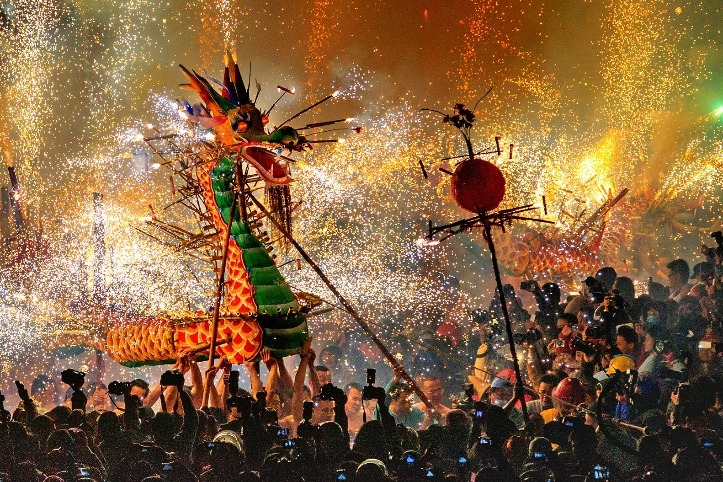
In the Guangdong-Hong Kong-Macao Greater Bay Area, the dragon and lion dance and Yingge folk dance continued to win crowds during the holiday. Kaifeng attracted tourists with Song Dynasty (960-1279) culture and history, temple fairs and delicious snacks.

Blockbuster films released during the Spring Festival holiday also boosted domestic tourism. Scenes from the martial arts film Blades of the Guardians were shot in Turpan and Karamay in the Xinjiang Uygur autonomous region, boosting search volumes for these destinations on Mafengwo.
Bookings for outbound travel services surged nearly 30 percent year-on-year during the holiday. The top five outbound destinations were Malaysia, Singapore, Thailand, Vietnam, and Indonesia. The Milano-Cortina 2026 Winter Olympics drove a 310 percent surge in tourism interest in Italy during the Spring Festival holiday.