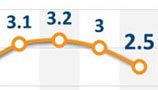
Property investment, a key component of fixed-asset investment in China, grew by 16.4 percent in the first four months, a further dip from the 16.8 percent expansion of the first quarter. Newly started building construction in the first four months of the year actually slumped by 22.1 percent year-over-year in terms of floor space, according to the National Bureau of Statistics.
 |
|
 |
Zhu said several factors contributed to it. A major reason, he said, is that too many large enterprises in the steel, metal, coal and chemicals - sectors with overcapacity - as well as local government financing vehicles eat up too much credit.
Burgeoning wealth management products and online financial products are competing with commercial banks for household deposits, pushing up the cost for banks to get the deposit. The interest rate liberalization process also has taken a toll, according to Zhu.
Regulations linking banks' loan ability with their deposit reserve, which forced banks to grab deposits at the end of a quarter or a month, has exacerbated the matter, he said.
Addressing structural problems, such as gradually eliminating overcapacity, strengthening oversight on online financial products and relaxing the stringent loan-to-deposit ratio, is critical to bringing down borrowing costs, Zhu said.
But as these reforms take time, more flexibility in monetary policy could ease the problem in the short term, he said.

Copyright 1995 - . All rights reserved. The content (including but not limited to text, photo, multimedia information, etc) published in this site belongs to China Daily Information Co (CDIC). Without written authorization from CDIC, such content shall not be republished or used in any form. Note: Browsers with 1024*768 or higher resolution are suggested for this site.
License for publishing multimedia online 0108263 Registration Number: 20100000002731