Guge, A Lost Kingdom In Tibet
Updated: 2007-08-02 08:40
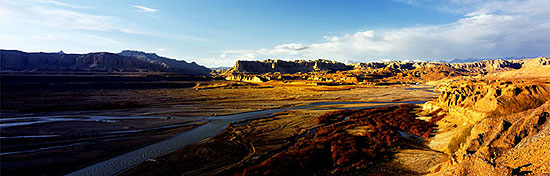
The ruins of Guge are in what is today Zhada County, Ngari Prefecture, Tibet. Guge is said to be the highest of ancient kingdoms located on the ridge of the Roof of the World, as Tibet is called. Marching westwards to Guge from the Tibetan capital of Lhasa is a long and hard journey that crosses a vast uninhabited desert.
Legend has it that in the first half of 20th century the Tibetan government sent a soldier to Guge to collect taxes. However, a couple of days later the soldier was back, frightened. All he could see there was a world of sand. The government dropped the taxation plan.
However barren, desolate and inaccessible the land might seem, the powerful Guge kingdom ruled over it for over 700 years from the 9th to 17th century. Altogether 16 kings ruled Guge. Yet, historical records reveal little about its rise and sudden demise. It was instead from some letters by western missionaries that people got to know more about the lost empire.
Ruins, the only visible legacy
Records show that Guge once made great religious and economic achievements. However, its glory was reduced to pieces when the mighty kingdom was involved in a fatal war in the 17th century. The invasion of the neighboring state Ldakah, coupled with the domestic rebellion of Guge monks, brought the kingdom to its knees.
The ruins are the only visible legacy Guge has left
behind.The ruins extend from the mid-ridge of a hill 300 m high at its peak and
cover an area of 720,000 sq m. It is the second largest ruin in Tibet, after the
Potala Palace in Lhasa. Archaeologists have unearthed 445 earthen and wooden
structures, 879 caves, 58 blockhouses (a kind of fortification building), four
secret tunnels, 28 stupas (traditional pagoda-shaped Buddhist monuments),
granaries and weaponry storehouses.
| 1 | 2 | 3 | 4 | 5 |  |