One-child rule to remain until new policy comes into effect
 |
|
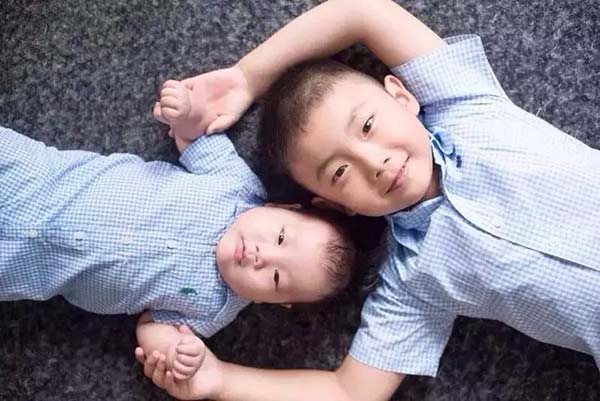
A boy with his younger brother. [Photo by Zhai Xiaoyan/Provided to chinadaily.com.cn] |
China's top family planning authority has stressed that its local affiliates must implement the current one-child policy until a new policy allowing all couples to have two children goes into effect after being ratified by legislators.
Local authorities in each province should not carry out the two-child policy "wilfully," the National Health and Family Planning Commission (NHFPC) said on Sunday, refuting claims by one local official that the new policy was effective as soon as it was announced.
"Those pregnant with a second child will not be punished as of today," Zhan Ming, deputy director of the provincial health and family planning commission in central China's Hunan Province, was quoted as saying by Hunan Daily on Oct 30.
The Communist Party of China announced the abolishment of its decades-old one-child policy at the close of a key meeting on Oct. 29, in an attempt to balance population development and offset the burden of an aging population.
According to a communique released after the plenum, a final plan for the policy change will be ratified by the annual session of China's top legislature in March.
The NHFPC estimated that about 90 million families may qualify for the new two-child policy, which would help raise the population to an estimated 1.45 billion by 2030. China, the world's most populous nation, had 1.37 billion people at the end of 2014.
The one-child policy was introduced in the late 1970s to rein in the surging population by limiting most urban couples to one child and most rural couples to two children, if the first child born was a girl.
The policy was later relaxed to say that any parents could have a second child if they were both only children.
It was further loosened in November 2013, with its current form stipulating that couples are allowed to have two children if one of them is an only child.

