 |
|
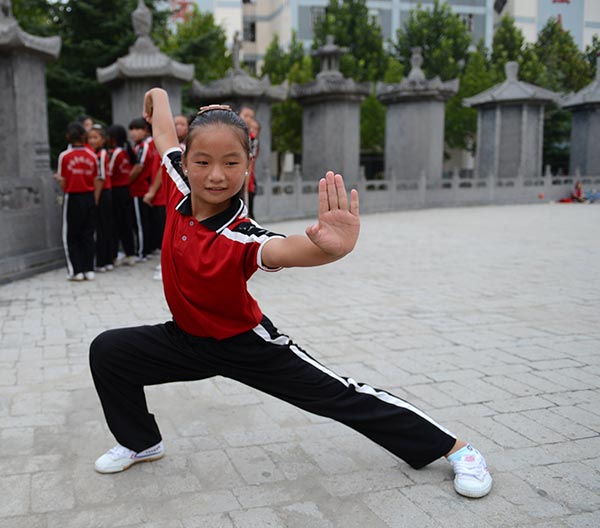
Children learn kung fu in a school of the Taguo Education Group in Dengfeng, Henan. [Photo by Xiang Mingchao/China Daily] |
Senior executives of Shaolin, students, tourists and representatives of the Taguo martial arts school in Dengfeng, tell China Daily in interviews that Shaolin continues to influence many in today's world.
The discipline, which combines Chinese Zen Buddhism with martial arts, is believed to have been started by an Indian monk named Bodhidharma who came to Henan in the 6th century. The temple describes him as the first of six "patriarchs" of the monastic order. Chan, the Chinese word for Zen, was derived from the Sanskrit word dhyana or "mediation".
The institution thrived in imperial China, especially under the Tang Dynasty (AD 618-907), but kung fu was banned in the Qing Dynasty (1644-1911) as the royals feared a coup by the "warrior monks". Then, in the days of the Republic of China, the temple was set ablaze in 1928 by a warlord. Shaolin was dealt another blow during the "cultural revolution" (1966-76).
Its revival came in the 1980s and '90s on the heels of China's economic reforms. The buildings were rebuilt with private donations and government grants.
"Shaolin advocates health, justice and wisdom," says Wang Yumin, who heads the foreign affairs office of China Songshan Shaolin Temple, adding that the culture is passed down generations.
"The temple can be demolished but the spirit can't," he says of Shaolin's survival through the ages.
|
|
|
|
|
|
|
|

Copyright 1995 - . All rights reserved. The content (including but not limited to text, photo, multimedia information, etc) published in this site belongs to China Daily Information Co (CDIC). Without written authorization from CDIC, such content shall not be republished or used in any form. Note: Browsers with 1024*768 or higher resolution are suggested for this site.
License for publishing multimedia online 0108263 Registration Number: 20100000002731 
























 Raymond Zhou:
 Pauline D Loh:
 Hot Pot
 Eco China
 China Dream
 China Face