



Sightings of Amur tiger families show nation's conservation efforts paying off









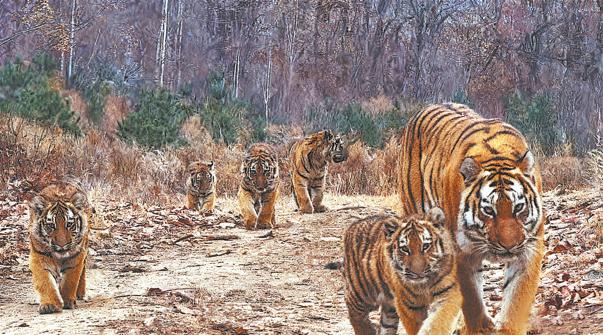
A camera trap in Northeast China Tiger and Leopard National Park has captured the country's first-ever footage of a wild Amur tigress raising five cubs, providing rare evidence of progress in rebuilding the species' fragile wild population, the World Wildlife Fund China said on Friday.
The footage, recorded in November in Hunchun, Jilin province — part of the world's largest tiger reserve — shows the adult tigress caring for her five cubs. Based on analyses of physical traits and gait, the tigress is estimated to be about 9 years old, while the cubs are believed to be 6 to 8 months old, WWF China said in a media statement.
WWF China noted that litters of five are "extremely rare" for wild Amur tigers, which typically give birth to one to four cubs, even under ideal conditions with abundant prey. The fact that all five cubs have survived in an area where prey populations are still recovering makes the case particularly remarkable, the organization said.
Rangers also captured images last month of another Amur tigress, estimated to be 5 to 8 years old, accompanied by four cubs believed to be 6 to 8 months old, also in Hunchun.
As an apex predator, the Amur tiger is highly sensitive to habitat integrity and the health of the food chain. Sustained sightings of tiger families and evidence of robust reproduction in the Hunchun protected area underscore the effectiveness of long-term conservation efforts, WWF China said.
"This demonstrates both the high quality of the tiger's habitat and the sustained effectiveness of long-term conservation measures, including habitat protection, enhanced patrolling, anti-poaching measures and human-wildlife conflict management," the organization said, adding that these efforts have contributed to a broader recovery in biodiversity.
Also known as Siberian tigers, Amur tigers are primarily found in Russia's Far East region and Northeast China. They are among the world's most endangered big cats and a flagship species of forest ecosystems. Only 12 to 16 were believed to be living in the wild in China in 1998.
There are now about 70 wild Amur tigers in the Northeast China Tiger and Leopard National Park.
Stuart Chapman, leader of WWF's global tiger program Tigers Alive Initiative, said the footage of the six-member tiger family "literally took my breath away".
"China's commitment to tiger conservation is delivering incredible results and creating a bright future for these magnificent cats," he said.
Zhou Fei, chief program officer of WWF China, said the footage underscores the effectiveness of China's conservation actions and boosts confidence in protecting other rare species.
"Years of conservation efforts show that saving tigers is possible," Zhou said. "Amid the current global acceleration of nature loss,'the return of the roar' brings hope and strength for the restoration of endangered species and their habitats."






- Sightings of Amur tiger families show nation's conservation efforts paying off
- PLA Ground Forces conduct long-range live fire drills to the north of Taiwan
- Fishing ban revitalizes Yangtze
- Chinese researchers establish new model to predict human organ aging
- Record set in high-speed maglev tech
- Xi'an expands subway network to 422 kilometers with new automated line