


Folklore beats with a modern pulse
Animated anthology returns, blending ancient stories and sharp visuals, Wang Xin reports in Shanghai.










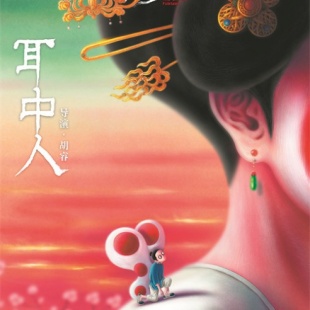
The story is adapted from Qing Dynasty (1644-1911) novelist Pu Songling's masterpiece Liaozhai Zhiyi (Strange Tales from a Chinese Studio). Departing boldly from the original narrative framework, the episode embodies the protagonist's inner desire as a yaoguai (supernatural being), residing in the ear.
Through the protagonist's struggle with the yaoguai, the story presents a direct confrontation, dialogue and eventual reconciliation with personal desire. It suggests that the true challenge lies not in silencing inner voices, but in listening to and understanding them — a dilemma that continues to resonate with contemporary audiences.
In addition to the storytelling, the new season also actively explores new aesthetics and diverse expressions in the making. Ancient Chinese paintings and intangible cultural heritage elements like Nuo Opera are vividly blended in How to Become Loongs. In contrast, Man in the Ear crafts a distinctive, artistic and immersive audiovisual experience, with a cinematic quality and an innovative ASMR (autonomous sensory meridian response) sound design.
"Compared with my work in the previous season, we made greater efforts to achieve a cinematic quality while integrating Chinese supernatural imagery in this episode. Beyond stories and imagination, we also designed a film-level novel and unique sound experience. I strongly recommend that the audience wear headphones to fully capture the sound details," says Hu.
Among the remaining seven episodes of Season 2, The Headless Warrior draws inspiration from the ancient Chinese classic Shan Hai Jing (Classic of Mountains and Seas), and the heartwarming family story of Magic Garlic is the only sequel to a Season 1 episode. Technically, Xiao Xue adopts the art form of wool-felt stop-motion animation to tell a quiet, emotional story of a mother and a son, and Safe Zoo experiments with the mockumentary format in animated form.

"Yao — Chinese Folktales 2 is remarkable in many ways. It ultimately explores and portrays how individuals discover themselves, find their true selves, confront their inner worlds, and achieve growth through life's journey," said Chen Liaoyu, chief director of the new season, at a recent event in Shanghai.
Chen pointed out that the series also pays tribute to the innovative spirit of Chinese animation, referring to "not imitating others, nor repeating themselves". The whole production team is sticking to this spirit, and hopes more young directors will join future projects rooted in Chinese cultural identity.

In 2023, Yao — Chinese Folktales premiered on Bilibili and became an instant hit. It amassed 360 million views and 798,000 bullet comments on the platform that year. During its two-month release period, more than 20,000 creators produced nearly 40,000 fan-made videos, with related derivative content garnering over 300 million views, according to Bilibili.
Last year, Nobody, a feature-length spinoff adapted from one episode of the series, became a blockbuster film, earning nearly 1.72 billion yuan ($246.32 million).
"Chinese animation is moving forward, and so are we. We do not claim to 'represent' anything, but just keep exploring earnestly. It is the overall growth of China's animation industry that has enabled us to realize more of our ideas," says Chen.