


Sustained efforts supercharge flyway routes









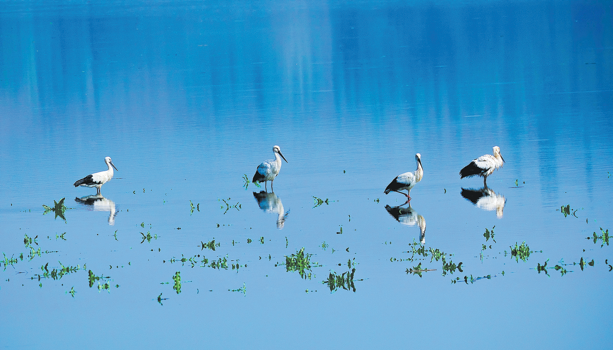
On a winter afternoon in mid-December, two bar-headed geese — known for soaring across the Himalayas — foraged in paddy fields along the Yangshi section of the Chongling National Wetland Park in Guiyang county of Hunan province.
Their appearance set a new bird-sighting record for the city and reflected a broader shift in that wetlands in southern Hunan are becoming indispensable "rest stops" on one of the world's busiest migration corridors.
Birds moving along the East Asian–Australasian Flyway travel thousands of kilometers each year. Chenzhou sits on a crucial inland passage.
"From Siberia southward, this is one of the world's nine major migration routes," said Zhang Ji'an, head of the Chenzhou Biodiversity Conservation Association.
Reaching Dongting Lake, the route splits with one branch following the Luoxiao Mountains — China's second-largest inland migration channel — while others traverse the Xuefeng and Wuling ranges. Many species pause in Zixing, Guiyang and Guidong before flying south.
"For many birds, Chenzhou isn't the final destination," Zhang said."But it is a highway service area. Without food from local wetlands, they cannot continue."
The Chongling Wetland is a reservoir-river complex extending 53 kilometers. It was designated as an internationally important wetland in 2022, according to wetland official Xie Fengguang.
Birds, he said, are "the soul of the wetland". Each year, more than 50 species — over 20,000 birds — arrive to rest and feed. Shallow and deep zones create ideal feeding conditions. Some species even settle and breed.
Recent visitors included "unexpected guests", said Tang Zhiguo, an education officer at the park, listing common cranes, whooper swans, swan geese, scaly-sided mergansers, oriental storks and black storks. Their presence signals improving ecological quality and effective protection.
Among the most symbolic arrivals are Chinese mergansers — a national first-class protected species with fewer than 3,000 individuals recorded worldwide. Eight visited Chongling in early 2025.
Tang noted the bird functions as an "ecological litmus test", indicating clean water and a suitable habitat. The Chongling Wetland maintains Class II water quality, sometimes better. In 2024, its Guiyang stretch was listed among Hunan's "Beautiful Rivers and Lakes".
Behind these outcomes lies careful management involving 16 infrared cameras for 24-hour monitoring, partnerships with universities, and a biodiversity database that informs targeted patrols across 12 protection points using both personnel and drones.
Restoration measures have dismantled former fish farms, rebuilt shorelines and created habitat islands. Former fisherman Luo Xiaojun, who now cultivates nearly 3.33 hectares of cropland, said the transition offers "more promise" while improving the bird habitat.
In Renyi town, a "100-meter service circle" keeps riverbanks clean, and market-based sanitation contracts reward thorough removal of trash. "The more garbage we transport away, the cleaner the environment," said the town's Party secretary Zhou Haiyan.
Further south, Bamianshan — rising above 2,000 meters — serves as another vital stopover. "It works like a fueling station," said station chief Guo Yijun. Exhausted birds feed, rest and either overwinter or continue south. Guo's seven-member team conducts patrols by drone and on foot, supports research and responds to emergencies.
One recent rescue involved a Hainan night heron found weak and starving. "After feeding it loaches, it recovered and was released,"Guo said.
Similar cases occur annually, even at night during patrols on migration routes. Awareness campaigns have sharply reduced illegal hunting, while the recovery of vegetation and abundant food is attracting birds back.
After eight years on the job, Guo describes the work as demanding yet meaningful — recalling a rehabilitated owl that lingered after release.
Hunan has five wetlands on the international list — three in Dongting Lake, plus Chongling and Maolihu. As the southernmost site, Chongling acts as both an ecological buffer and a governance pilot.
Liu Weiping, a professor at Xiangnan University and a leading expert on harmonious rural construction in Hunan, said that wetlands use "system thinking" to modernize ecological management, reinforcing the Xiangjiang River basin and forming an ecological corridor linking the river and marsh.
Legal protection is also tightening. A revised provincial wetland protection regulation, effective since Jan 1, provides a stronger safety net for restoration and management.
Wetlands, Liu said, are "life-support systems" that regulate climate, purify water and shelter species — and are costly, sometimes impossible, to repair once damaged.
From Dongting's great lakes to Chongling's quiet channels, the pattern is clear: once wetlands heal, birds return. Zhang Ji'an added that birds cannot be "attracted through investment promotion". They come only when they perceive safety — and stay when land and water allow life to thrive.
Contact the writers at zhaoruinan@chinadaily.com.cn