


Livigno chases snow sports cool factor
Northern Italian Alpine skiing town looks to redefine itself as a snowboarding and freestyle mecca










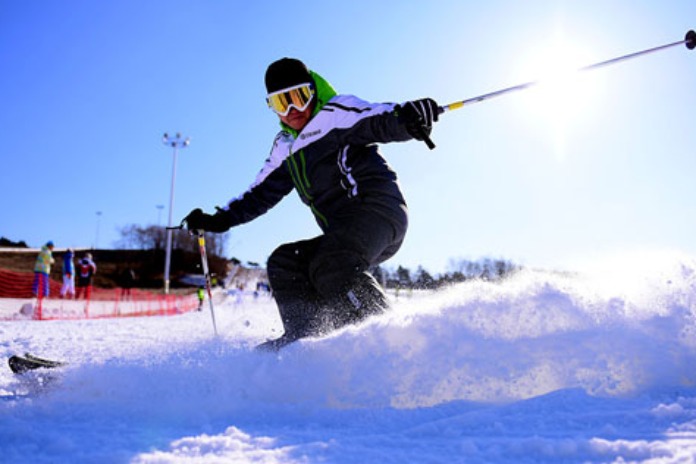
Italy's winter sports reputation has long been defined by Alpine skiing, but Livigno wants to seize the Milano-Cortina 2026 Winter Olympics as a once-in-a-lifetime chance to flip that script.
The northern Italian town is banking on the home Games to enhance its status as a center of excellence for freestyle skiing and snowboarding, disciplines that have surged from a grunge-tinted subculture to become fast-growing, youth-driven mainstream attractions.
After some 300 million euros ($360 million) of public and private investments ahead of the Olympics, Livigno is betting big on world-class facilities.
Local politicians and entrepreneurs are looking to the Games to attract ? ?higher-spending visitors and open up new markets — such as China, Japan and the United States — without necessarily increasing overall numbers.
"The strategy is to get to this great and unique event wearing our finest," Marco Rocca, CEO of Livigno's Mottolino ski area, told reporters.

Fresh investment
Livigno, one of a group of mountain venues for the Olympics, is already established as a base for snowboard and freestyle — a natural playground, the terrain, infrastructure and culture of which have attracted riders from across the world.
Over 50 million euros have been invested in the last four years in upgrading Mottolino, now equipped to host halfpipe, big air, slopestyle, ski and snowboard cross and parallel giant slalom (PGS), all feeding into a single finish zone to enhance the fan experience. Lift capacity is being expanded with a new high-speed cable car and an eight-seater chairlift, an upgrade aimed at both the Olympics and for the longer term.
"(With) snowboard and freestyle we will be able to guarantee a consistently young clientele ...not just athletes or those who practice these sports, but also those who want to keep in touch with this scene. It's not just about sports, but also about identity", Rocca added.
Luca Moretti, head of the local tourism promotion agency, echoed Rocca's words, adding that after the Olympics, Livigno "will change its skin, in qualitative terms more than quantitative ones".

Whatever the weather
The high-Alpine setting, isolation and long winters are Livigno's greatest assets.
At 1,816 meters the venue sees plenty of snowfall, but the capacity to generate more has been expanded thanks to a snow-making complex with cannons fed from a reservoir boasting a capacity of more than 200,000 cubic meters of water.
The system is complemented by so-called snowfarming, the technique of collecting snow and storing it to use it again when needed.
With a stockpile that can be deployed before natural snowfall arrives or after it melts, it helps Livigno give continuity to its already very long season, protecting training blocks and event windows and reducing the risk of weather-related disruptions.
"Livigno is known for its guarantee of snow and cold weather,"Moretti said.
The snow systems are designed to outlast the Olympic competition, giving the resort resilience against volatile winters and offering coaches, teams and visitors predictable seasons.
US freestyle skier Jaelin Kauf said that last season's World Cup stop offered a preview of what the Games could deliver.
"It was a great course. It's long, it's steep, the jumps were great. It goes right down to the bottom of the mountain into the village, so I think it's going to be a really great Olympic venue," she said.

In tune
Livigno's push comes at a strategic moment, following freestyle skiing and snowboarding's rapid evolution from niche, countercultural pursuits into mainstream global phenomena.
Freestyle events draw young fans with their photogenic mix of style, risk and rapid technical innovation.
Snowboarding, once viewed as an unruly alternative to skiing, surged in popularity through the 1980s and '90s, and its 1998 Olympic debut in Nagano, Japan cemented its wider appeal, turning the cool outsider discipline into a driver of audiences and participation. Organizers are counting on Italian athletes — with home hopes resting on the likes of freestyle-skiing siblings Flora and Miro Tabanelli and Italian riders Lucia Dalmasso and Maurizio Bormolini — to chase medals that could elevate both Livigno's profile and Italy's standing.
"Livigno has always been a mecca for winter sports, particularly snowboard and freestyle. The shape of the terrain, the facilities and the atmosphere make it an internationally sought-after destination," Bormolini, who was born in nearby Tirano and is based and trains in Livigno, told reporters.
He said recent upgrades have made the slopes and the snow surface consistently of the highest standard, helping athletes deliver ? ?top-level results.
The home Games, Bormolini added, will consolidate Livigno as a world capital for winter sports and "inspire the next generation".
"It will be an event that leaves an indelible mark on our community and our territory," he said.


Most Popular
- Nation's soccer strength reboots for a new era
- Champions lead Winter Olympics quest
- China's U23 captain Xu Bin set to join Premier League club Wolves
- U23 near miss brings hope and lessons for Chinese soccer
- Short track skaters named flag bearers as Hungary unveils 2026 Winter Olympic squad
- China's historic run at AFC U23 Asian Cup sparks praise