
The China Story
at your Fingertips
OPEN

Russia's President Vladimir Putin says his country will continue its yearlong "special military operation" in Ukraine, and he accused the US-led NATO alliance of fanning the flames.
Russia-Ukraine conflict would have cost world economy $1.6 trillion in 2022, according to a study published by the German Economic Institute.
MOSCOW -- A meeting between Russian President Vladimir Putin and Ukrainian President Volodymyr Zelensky is possible only after a peace treaty is ready, Kremlin spokesman Dmitry Peskov said on Tuesday.
"Nothing has changed for us. We do not reject the possibility of such a meeting for our president," Peskov told a daily briefing.
"But we repeat once again that such a meeting is possible only after the text of the document is agreed upon," he said.
Moscow and Kyiv have conducted several rounds of negotiations aimed at finalizing a treaty to end the ongoing crisis in Ukraine.



KYIV - More than $20 billion of international aid has been allocated for Ukraine amid its conflict with Russia, the Interfax-Ukraine news agency reported on Tuesday, citing Kyrylo Shevchenko, governor of the National Bank of Ukraine.
"The financial aid allocated for Ukraine by now exceeds $20 billion. A part of it has already been disbursed," Shevchenko was quoted as saying.
In March, Shevchenko said that international donors have pledged $15 billion in financial, technical and humanitarian aid for Ukraine.

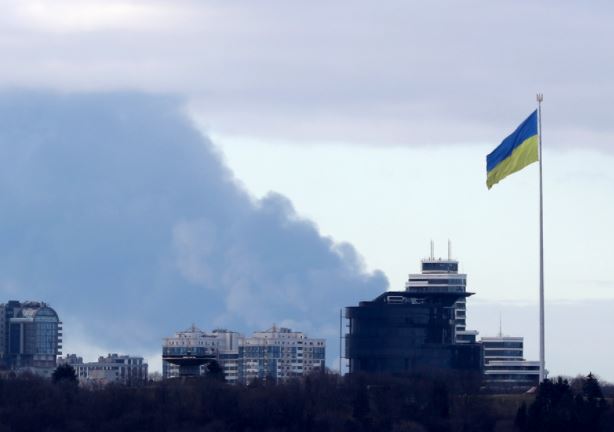
Ukraine established seven humanitarian corridors on Tuesday, Ukrainian Deputy Prime Minister Iryna Vereshchuk said on Telegram.
One humanitarian corridor was set up to allow civilians to leave the conflict-torn city of Mariupol via private transport, Vereshchuk said.
Other humanitarian routes were established to evacuate people from Tokmak and Berdyansk towns in the southern Zaporizhzhia region and from four settlements in Lugansk, the official said.
On Monday, 3,376 people were evacuated from conflict-affected areas in Ukraine.


The disinformation campaign being waged against China over the Ukraine crisis has reached new heights, with The Times newspaper running a report on Friday accusing China of hacking Ukraine's defense and security departments before Russia's "invasion".
Citing anonymous United States intelligence service and Ukrainian security service sources, the report is just the latest effort by the US and its cronies to take advantage of the Ukraine crisis to stigmatize China, after their previous claims that China knew of Russia's "invasion" of Ukraine in advance and China is providing Russia with military assistance proved to be lies.
The Ukrainian security service promptly denied the claim soon after the report was published.
China gains nothing from the conflict, while the US is benefiting tremendously from it. Not only has it been able to weaken Russia, tighten its grip on Europe and drive a wedge between the European Union and China, all at the cost of Ukraine, but its military-industrial complexes and energy and financial sectors are all minting money.
The disinformation campaign being carried out against China is an integral part of this multipronged scheme, which has been disastrous for the rest of the world. The hacking claim is just another attempt by the US to smear China. Like the previous attempts to scapegoat China for US job losses, economic difficulties and ineffectual response to the COVID-19 pandemic, the US is seeking to portray China as acting maliciously.
Yet that shoe is on the US' foot. According to the National Computer Network Emergency Response Technical Team/Coordination Center of China, hackers with IP addresses in the US have markedly intensified their endeavors since late February to attack and control computers in China.
As State Councilor and Foreign Minister Wang Yi said in his telephone talk with Ukrainian Foreign Minister Dmytro Kuleba on Monday, China will by no means pour oil on the flames of the conflict and it will not observe Ukraine's troubles with indifference.
China has been very consistent in its position. It has repeatedly called for the de-escalation of the conflict with the aim of minimizing civilian losses and for negotiations to find a way to end the fighting as soon as possible. That's exactly what China will continue to do. Expressing appreciation for China's humanitarian aid for his country, Kuleba said Ukraine fully recognizes that China is acting as a positive power and hopes that it will continue to play a role in serving the interests of peace.
As the only country among the permanent members of the United Nations Security Council to have no direct geopolitical interests in the Ukraine crisis, China also "stands ready to play a constructive role" with regard to establishing a balanced, effective and sustainable security mechanism that can maintain lasting peace and stability in Europe.


The drive to reduce harmful emissions by ensuring people park their gas-guzzlers in favor of hybrid or electric vehicles is under threat from the situation in Ukraine.
Russia's special military operation and the sanctions that followed limiting Moscow's exports have driven up the cost of cobalt, lithium, and nickel — key raw materials in the production of the batteries that power electric vehicles.
Battery producer Farasis Energy told the Financial Times newspaper that, a year ago, a battery for a sport utility vehicle needed the three ingredients in quantities that cost $1,395. Today, they would cost $7,400.
"At the moment, the raw material prices are a burden for our target to reduce battery costs," Jurgen Rittersberger, Audi's chief financial officer, told the paper.
Audi — which has said it will only produce battery-powered cars from 2026 — and other automakers, battery producers, and suppliers are now crunching the numbers in the face of shrinking profit margins.
Other materials used in auto production have also become more expensive because of the situation in Ukraine, such as aluminum and steel.
Arno Antlitz, Volkswagen's chief financial officer, told the Financial Times: "We also need, for example, rhodium, palladium, and platinum for the (catalytic) converters in our (combustion engine) cars."
So far, automakers have not been passing on those higher costs by raising the price of their products, and many have been using stockpiles of raw materials while sourcing cheaper alternatives.
Moreover, demand for electric vehicles has never been stronger.
The AutoTrader website, which is the United Kingdom's largest virtual marketplace for cars, said nearly a quarter of searches during March were for electric vehicles, up 15 percent on a month earlier. Fast-rising petrol prices attributed to the unrest in Ukraine was the main driver for the increased interest in electric vehicles.
The BBC reported on Monday the strong interest in electric vehicles has translated into a record quarter for producer Tesla, which delivered more than 310,000 vehicles in the first three months of the year, up 70 percent on the same period last year.
Chief executive Elon Musk said on Twitter the production was achieved in spite of rising costs, shortages, and the pandemic, which triggered lockdowns in some parts of China, where the company has its main factory.
"This was an exceptionally difficult quarter due to supply chain interruptions," he wrote. "Outstanding work by Tesla team and key suppliers saved the day."
There was more good news for the electric vehicle market on Monday, with the Express newspaper reporting researchers from the School of Chemical Engineering and the Australian Institute for Bioengineering and Nanotechnology at the University of Queensland had claimed to have developed lithium-ion battery nanotechnology that doubles the lifespan of high-voltage batteries.
The paper quoted professor Wang Lianzhou as saying: "Our process will increase the lifespan of batteries in many things from smart phones and laptops, to power tools and electric vehicles."

KIEV -- Ukrainian President Volodymyr Zelensky has signed a decree to approve the composition of a Ukrainian delegation for the talks with Russia over security guarantees, the Ukrainian president's press service said Monday.
The delegation will be led by David Arakhamia, head of the Ukrainian delegation to the peace negotiations with Russia, according to the decree.
Ukraine's Justice Minister Denys Malyuska, Adviser to the Head of the Presidential Office Mykhailo Podoliak, Defense Minister Oleksiy Reznikov, and six other Ukrainian officials will be members of the delegation, the decree said.
On Saturday, Arakhamia said that the draft agreements that had been discussed during the Ukraine-Russia meeting in Istanbul were ready for discussion by the presidents of Ukraine and Russia.
At the face-to-face negotiations in Istanbul, Kiev proposed to sign a new international treaty on security guarantees, which enshrines obligations for the guarantor countries to provide Ukraine with military assistance in the event of an attack.

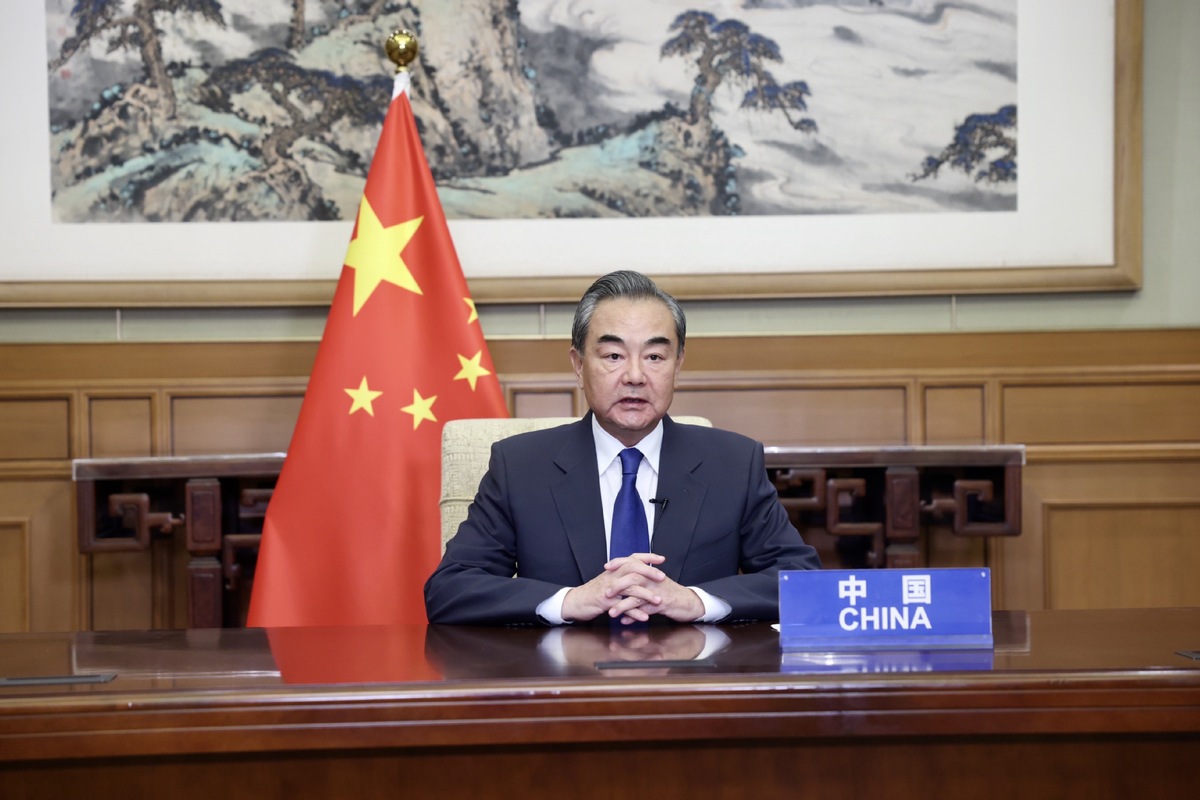
China does not seek selfish geopolitical gains or to do anything that adds fuel to the fire over the Ukraine crisis, and peace is the only goal that the nation has been hoping for, State Councilor and Foreign Minister Wang Yi told his Ukrainian counterpart Dmytro Kuleba on Monday.
In a phone conversation with Kuleba, Wang reiterated Beijing's position encouraging peace talks over the Ukraine issue, saying that it has long been China's historical and cultural tradition and its consistent foreign policy to uphold peace and oppose war.
China welcomes peace talks between Russia and Ukraine, and the two sides should adhere to the general direction of talks in spite of all difficulties or conflicts, until they lead to a cease-fire and peace, he said.
China believes that the Ukrainian side has sufficient wisdom to make choices that fit in with the fundamental interests of its people, he said, adding that China will continue to play a constructive role from an objective and just position.
Kuleba said Ukraine attaches importance to China's global influence and prestige, and the nation hopes that Beijing can continue to play an important role in a cease-fire.
He expressed gratitude for China's humanitarian assistance, saying that Ukraine is still committed to peace talks with Russia to find a lasting solution.
In another development, Moscow has requested a special UN Security Council meeting on Monday to address claims that Russian forces had committed "atrocities against Ukrainian civilians" in Bucha, a town outside Kyiv.
Dmitry Polyansky, Russia's deputy ambassador to the United Nations, said Russia requested a meeting "in the light of heinous provocation of Ukrainian radicals".
Local authorities in Bucha said they had been forced to dig communal graves to bury the dead accumulating in the streets, including some found with their hands bound behind their backs in scenes that sent shock waves through international capitals more than a month into Russia's "special military operation".
Ukraine's President Volodymyr Zelensky was unsparing in his nightly video message, saying that "concentrated evil has come to our land".
Bucha Mayor Anatoly Fedoruk said 280 bodies were placed in mass graves because it was impossible to bury them, as cemeteries lay within range of ongoing shooting.
Satellite imagery company Maxar released photos it said showed a mass grave on the grounds of a church in the town.
On Monday, Russia's Tass News Agency quoted Russian Ambassador to the United States Anatoly Antonov as saying: "I would like to point out that Russian troops left Bucha on March 30. The Ukrainian authorities remained silent all these days, and now they have suddenly posted sensational footage in order to tarnish Russia's image and make Russia defend itself."
On Sunday, Russia's Defense Ministry denied Ukraine's accusations that Russian troops had killed civilians in Bucha, describing the video footage and photographs of dead bodies as a "provocation" and a "staged performance" by Kyiv for the Western media.
The ministry said that all Russian military units had left Bucha last Wednesday, and that civilians had been free to move around the town or evacuate while it was under Russian control.
Ukraine's Foreign Minister Dmytro Kuleba accused Russia on Sunday of a "deliberate massacre," while Zelensky's spokesman, Sergey Nikiforov, said the killings in Bucha look "exactly like war crimes."
The Russian Defense Ministry pushed back, saying "not a single local resident" in Bucha suffered violence during the time that Russian armed forces were in control of the settlement.
The United Nations Secretary-General Antonio Guterres tweeted on Monday that he was "deeply shocked" by images of dead civilians in Bucha, and he called for an independent investigation that "leads to effective accountability".
Separately, China denied a report by London-based The Times citing the Ukrainian security service about its involvement in "a cyberattack on Ukraine before Russian military action".
A spokesperson for Chinese embassy to the United Kingdom called the report "sheer irresponsible talk" and lacking in credibility.
The spokesperson said that for some time The Times' reports on China have been untrue, deliberately distorted and even slanderous and that this "seriously runs counter to the professional ethics of journalism and misleads the readers".
Agencies contributed to this story.

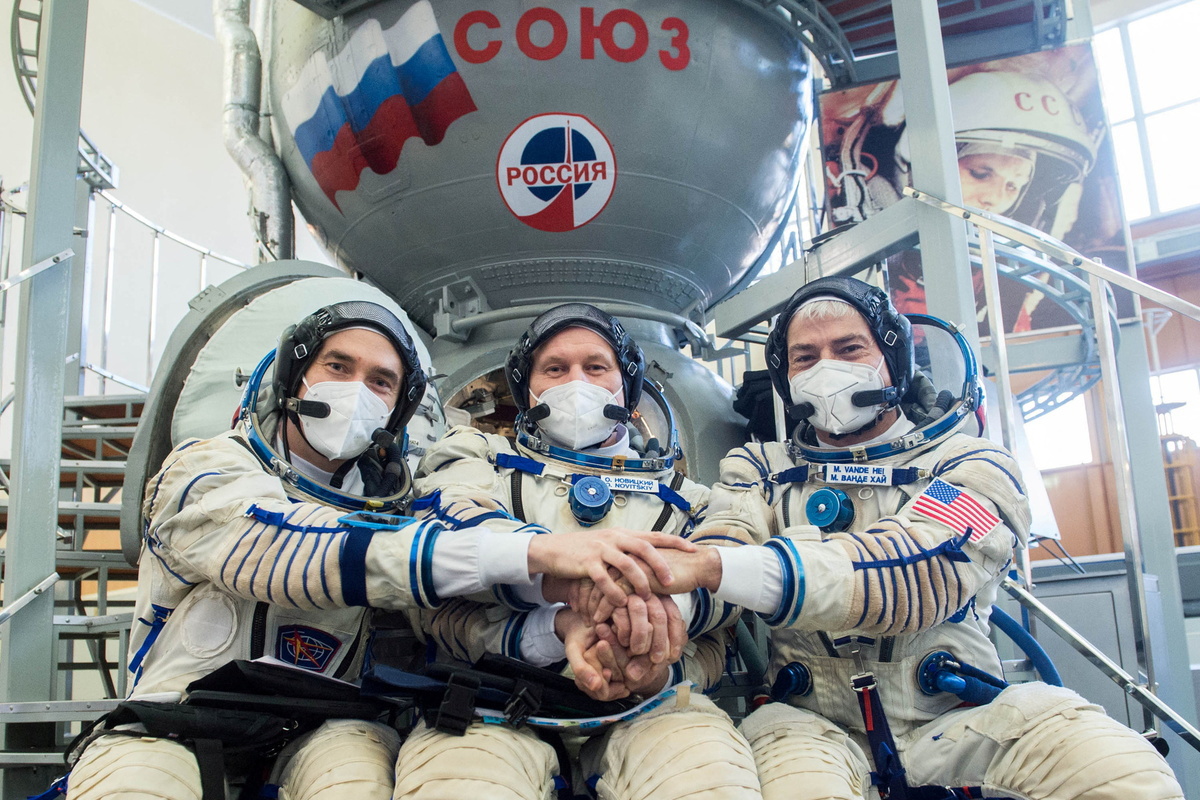
MOSCOW-The head of Russia's space program said on Saturday that the future of the International Space Station hangs in the balance after the space agencies of the United States, the European Union, and Canada missed a deadline to meet Russian demands for lifting sanctions on Russian enterprises and hardware.
Dmitry Rogozin, the head of Roscosmos, told reporters that the state agency is preparing a report on the prospects of international cooperation at the station, to be presented to federal authorities "after Roscosmos has completed its analysis".
Rogozin implied on Russian state TV that the Western sanctions, some of which predate Russia's current military operations in Ukraine, could disrupt the operation of Russian spacecraft servicing the ISS with cargo flights. Russia also sends manned missions to the space station.
He stressed that the Western partners need the space station and "cannot manage without Russia, because no one but us can deliver fuel to the station".
Rogozin added that "only the engines of our cargo craft are able to correct the ISS's orbit, keeping it safe from space debris".
Rogozin later on Saturday wrote on his Telegram channel that he received responses from his Western counterparts vowing to promote "further cooperation on the ISS and its operations".
He reiterated his view that "the restoration of normal relations between partners in the ISS and other joint (space) projects is possible only with the complete and unconditional lifting" of sanctions, which he referred to as illegal.
Rogozin said that Roscosmos' proposals on when to end cooperation over the ISS with space agencies of the United States, Canada, the European Union and Japan will soon be reported to Russian authorities. He has previously said that the sanctions could "destroy" the US-Russian partnership on the ISS.
The West has introduced sweeping sanctions against Russia over what Moscow calls a special military operation in Ukraine, launched on Feb 24.
Despite the tensions, a US astronaut and two Russian cosmonauts safely landed in Kazakhstan on Wednesday after leaving the space station aboard the same capsule.
The European Space Agency said last month it was suspending cooperation with Roscosmos over the ExoMars rover mission to search for signs of life on the surface of Mars.


West's push for increased supply harms diversification, climate goals, experts say
Western pressure on Gulf nations to pump more oil amid the Russia-Ukraine conflict could derail the region's economic diversification plans and its climate commitments, experts warn.
Saudi Arabia, the United Arab Emirates and Qatar-key members of the Organization of the Petroleum Exporting Countries-have remained hesitant to increase oil and gas exports amid pressure from the United States, European Union countries and Japan. The other Gulf Arab nations comprise Oman, Kuwait and Bahrain.
Russia is the world's largest exporter of oil to global markets, according to the International Energy Agency. The West's Arab oil push is aimed at stabilizing the global energy market and containing soaring prices spurred by the conflict in Eastern Europe.
Prices of fuel oil and gas have surged in the EU after the US and some EU countries imposed sanctions on Russia's exports. Oil prices hit more than $100 a barrel in March.
Salman Zafar, the founder of EcoMENA, an environmental think tank in Doha, Qatar, told China Daily that the realization of climate goals in the region covered by the Gulf Cooperation Council will be hampered if Saudi Arabia and the UAE decide to increase their oil output in return for geopolitical and economic leverage with Western countries.
"In the past decade or so, the Gulf countries have made steady progress, albeit slow, in transitioning to a low-carbon economy, but it may be undone if there is a renewed focus on oil production," said Zafar.
"Climate change mitigation is a one-way road, and the Gulf countries should be wary of long-term impacts of anthropogenic emission of greenhouse gases from the oil industry."
Yesar Al-Maleki, an energy expert and Gulf analyst at Middle East Economic Survey, an energy publication in Cyprus, said that in terms of economic diversification, an oil price boost is a "double-edged sword".
"Historically, these (diversification) plans would be abandoned with higher oil prices, which in turn lead to greater government spending within the economy. Oil volatility has always caused cyclical spending by Gulf countries," he said.
Al-Maleki said that while prices are high and oil revenues are up, GCC producers like Saudi Arabia and the UAE are keen to see their diversification plans go through. The higher revenues will see some of their climate ambitions financed, he said, but he also noted that the technologies still need time to mature and become commercially scalable.
In October last year, Saudi Arabia's Crown Prince Mohammed bin Salman launched the Middle East Green Initiative, aiming to secure about $10.4 billion for an investment fund and clean energy project to reduce regional carbon emissions. He also pledged that the country would reach net zero emissions by 2060 by investing more than $186 billion into the green economy over that time.
The UAE, also in October last year, announced its aims to hit net zero by 2050.
Energy security
Although leaders of the UAE and Saudi Arabia have reiterated the importance of global energy security and energy market stability, they have not increased output.
At the Doha Forum on March 27, Ahmad bin Mohamed Al Sayed, Qatar's minister of state and chairman of the Qatar Free Zones Authority, said oil-producing countries in the GCC must remain focused on their economic diversification efforts and strategies to become knowledge-based economies despite the recent surge in global oil prices, The Peninsula, an English-language daily in Doha, reported.
Anis Khayati, an economics professor at the College and Business Administration at the University of Bahrain, said it is shortsighted to imagine that the Gulf states have no interest in the Russian-Ukraine conflict. Therefore, appeals to increase oil production "have fallen on deaf ears".
Khayati believes the decline in relations between the "oil powers in the Middle East" and Washington could "rearrange" the regional order in the interest of the Gulf countries.
The Gulf also wants to convey a message to Washington that "this war is not our war, which is very similar to the message that the Americans have been sending them for several years about Yemen," Khayati said.
Zafar said Western powers, instead of asking the Gulf nations to spew more oil, should help Middle Eastern countries to set up more renewable energy plants and get access to the latest energy efficiency technologies.
Xinhua contributed to this story.
jan@chinadailyapac.com

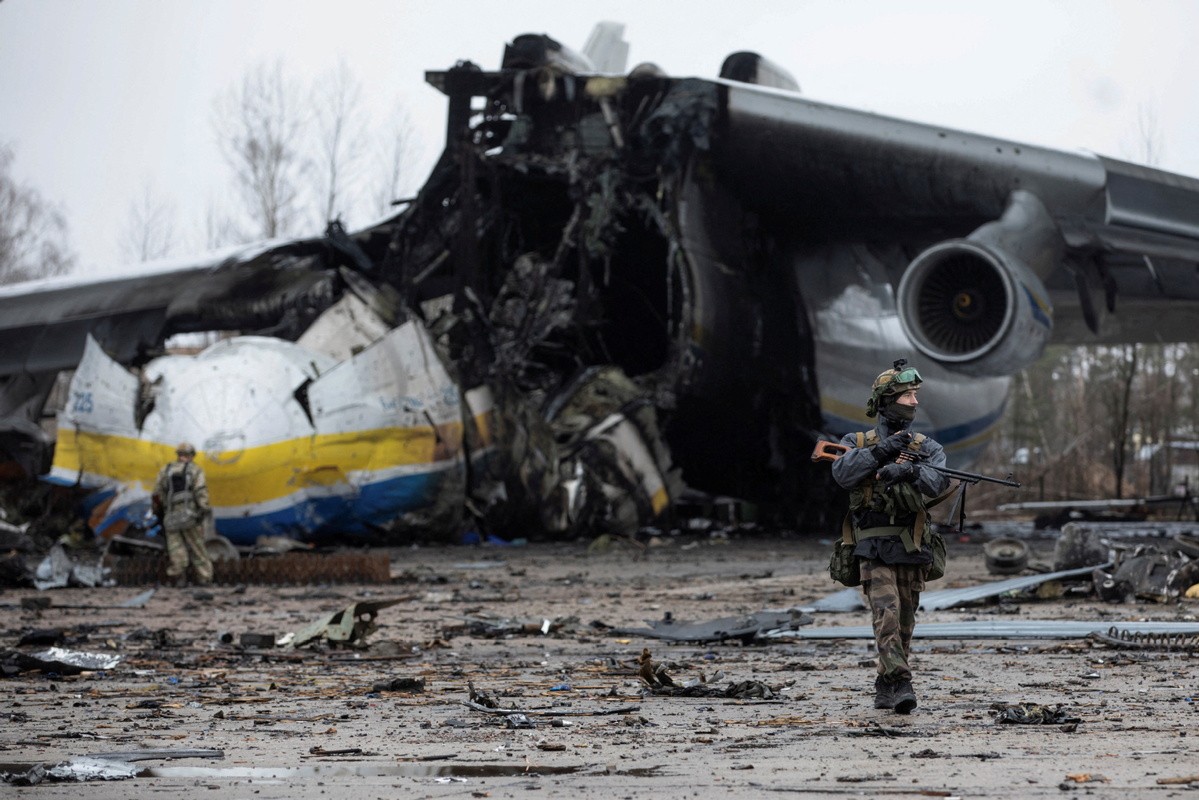
Russian gas continued to flow into Germany this weekend despite Berlin's refusal to adhere to President Vladimir Putin's demand for gas contracts to be paid in roubles.
"Gas is flowing to Germany. Deliveries are incoming. Supply security is still guaranteed," a German government spokesperson said on Saturday.
The German government is "in close contact" with its European partners and will "monitor the situation closely," the spokesperson added.
German transmission system operator Gascade, which manages the German section of the Yamal-Europe pipeline, said on Saturday that it couldn't confirm any cutting off of gas supplies to Germany.
Putin delivered an ultimatum on Thursday to "unfriendly" nations to pay for their energy in roubles starting Friday, or risk being cut off from vital supplies. However, German Chancellor Olaf Scholz insisted that German companies will continue to make payments for Russian gas in euros.
Kremlin spokesperson Dmitry Peskov said that Russia would not turn off gas supplies to Europe immediately as payments on deliveries due after April 1 are due in the second half of this month and May.
European buyers and governments are working on ways to potentially pay for gas in roubles. With weeks left before bills are due, governments in Europe, which relies on Russia for more than a third of its gas supplies, are talking to energy companies about Russia's demand.
The European Commission said on Friday that those with contracts requiring payment in euros or dollars should stick to the stipulated currency.
Russia's gas giant Gazprom announced on Friday that it will quit its business operations in Germany without giving any details or explanation of its decision.
Meanwhile, Ukraine said on Saturday its forces had seized back all areas around Kyiv, claiming complete control of the capital region for the first time since Russia launched the "special military operation" on Feb 24.
There was no immediate Russian comment on the claim, but its Defense Ministry spokesman Igor Konashenkov stressed Russia's combat effectiveness, saying aviation forces had struck 51 Ukrainian military facilities during the night.
Some US officials familiar with the latest US intelligence assessments said Russia has revised its strategy to focus on taking control of the Donbass and regions in eastern Ukraine with a target date of early May.
On Sunday morning, the southern port city of Odesa was hit by a Russian airstrike, Serhii Bratchuk, spokesman of the operational staff of Odesa regional military administration, said on national television. Several explosions were heard in the city before sunrise.
Konashenkov confirmed high-precision sea and air-launched missiles destroyed an oil refinery and three storage facilities near Odessa, which had supplied fuel to Ukrainian troops.
An article published by RT said the Russian Defense Ministry had identified US officials involved in developing biological weapons in Ukraine.
These officials were "the heads of divisions and employees of the US Department of Defense, as well as its main contractors," said the report, citing Konashenkov.


KYIV -- Ukraine has regained control of the "whole Kyiv region," Deputy Minister of Defense of Ukraine Hanna Maliar said on Facebook on Saturday.
Ukraine has retaken "Irpin, Bucha, Gostomel and the whole Kyiv region," said Maliar.
The Russian military continues to carry out systematic missile and aviation strikes on targets in Ukraine, but the intensity has decreased, said the General Staff of the Armed Forces of Ukraine.
Additional units of the Russian military are preparing to participate in combat in Ukraine, it added.

KYIV - Explosions rocked Ukraine's southern Black Sea port city of Odesa early Sunday as the city came under an airstrike, the Operation Command South, a formation of the Ukrainian Ground Forces in southern Ukraine, said on Facebook.
The attacks hit the city's infrastructure. Some of the missiles were intercepted by the air defense.
According to preliminary data, there were no reports of casualties from the strikes.
Smoke has been rising in various districts of the city.
Russian Defense Ministry spokesman Igor Konashenkov said the Russian Armed Forces have destroyed an oil refinery and three storage facilities for fuel and lubricants near Ukraine's Odessa with high-precision sea- and air-based missiles.
The facilities supply fuel to a group of Ukrainian troops in the Mykolaiv direction, Konashenkov said Sunday during a briefing.

MOSCOW - Moscow has information that an array of biological laboratories have been founded around Russia, which are engaged in developing bio-weapons, Kremlin spokesman Dmitry Peskov said Saturday.
"Within the framework of a program funded by the Pentagon, a whole network of biolabs have been created around Russia and Belarus, which not only deal with extremely dangerous pathogens, microbes, viruses, but also work on projects to invent new types of biological weapons," Peskov said in an interview with Belarus-24 TV channel.
"The Americans are now trying to divert attention from the issue of biological laboratories, but facts speak for themselves. The issue concerns Russia and many other countries," he said.
During Russia's special military operation in Ukraine, the dangerous biological activities of the United States had been revealed, Irina Yarovaya, deputy chairperson of the State Duma or the lower house of Russia's parliament, said earlier this week.
Russian lawmakers have formed a commission to investigate US-controlled biological laboratories in Ukraine.


KYIV -- The draft agreements that were discussed during the meeting in Istanbul this week are now ready for discussion by the presidents of Ukraine and Russia, head of the Ukrainian delegation David Arakhamia said Saturday.
The draft has been "developed enough to conduct direct consultations between the two leaders of the countries," Arakhamia was quoted by Interfax-Ukraine news agency as saying.
"Our task is to prepare the final stage not of the document itself, but of those issues that we touched upon, and to prepare the future meeting of the presidents," he said.
Ukraine's government-run Ukrinform news agency confirmed on Friday that the two sides have started the next round of peace talks via video, citing a member of the Ukrainian delegation Mykhailo Podolyak.
Russia and Ukraine held their latest round of face-to-face peace talks in Turkey's Istanbul on Tuesday, which lasted for about three hours.

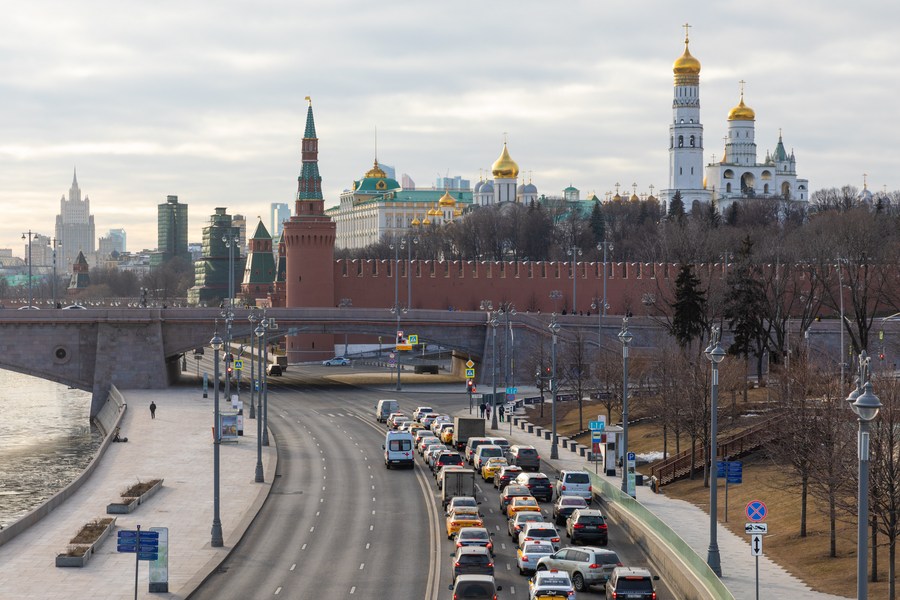
MOSCOW - Russia's Defense Ministry has found evidence suggesting Kiev was planning to use pathogens developed in Pentagon-funded biological laboratories against the population of Donbass and Russia, according to an article published on RT.
Alongside Kiev's intent, the defense ministry allegedly identified concrete US officials involved in developing biological weapons in Ukraine.
These officials were "the heads of divisions and employees of the US Department of Defense, as well as its main contractors," said the report, citing Russian Defense Ministry spokesman Igor Konashenkov.
Hunter Biden, the son of the current US president Joe Biden, was directly involved in these campaigns, Konashenkov said, citing investigations by Western media, adding Hunter Biden has worked closely with Pentagon contractor Metabiota, which specializes in research on pathogens that can be used to develop biological weapons.

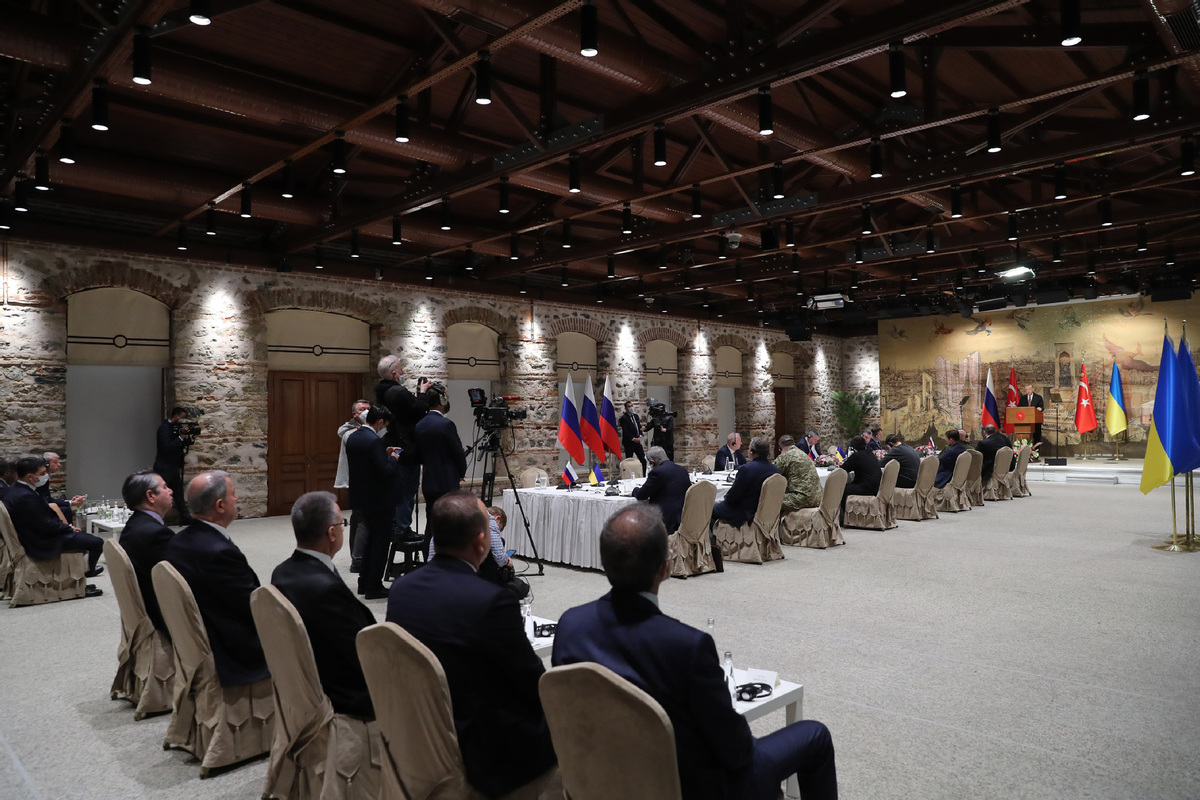
KYIV -- Ukrainian and Russian forces on Friday exchanged prisoners under an agreement reached by the two countries' negotiating groups earlier this week, said Kyrylo Tymoshenko, the deputy head of the Ukrainian president's office.
"The exchange has just taken place. 86 Ukrainian servicemen, including 15 women, are now safe," Tymoshenko said on Telegram.
The prisoner swap took place in Ukraine's southern Zaporizhzhia region, Tymoshenko said, without giving the number of captives released by Ukraine.
Ukraine and Russia held their latest round of face-to-face peace talks in Turkey's Istanbul on Tuesday.
Ukraine and Russia conducted their first prisoner swap last week since the start of the conflict on Feb 24, Ukrainian authorities said.


Moscow has announced it will launch an investigation into US-controlled biological labs in Ukraine, and Ukraine carried out its first airstrike on Russian territory on Friday.
A Russian parliamentary commission held its first meeting on Thursday, announcing the establishment of four working groups to investigate biological research by US specialists in Ukraine, according to a statement from the Russian State Duma, the lower house of the country's parliament.
During Russia's special military operation, the dangerous biological activities of the US on the territory of Ukraine were revealed, said Irina Yarovaya, co-chair of the commission and deputy chairperson of the State Duma.
"Dangerous both for Russia and for Ukraine itself. We are talking about secret activities controlled by the US Department of Defense, with signs of the development of biological weapons," she said.
The investment fund Rosemont Seneca, currently managed by US President Joe Biden's son Hunter Biden, financed the Pentagon's military biological program in Ukraine, the Russian Defense Ministry said last week.
US Undersecretary of State for Political Affairs Victoria Nuland has admitted that "Ukraine has biological research facilities".
Peace negotiations between Russia and Ukraine resumed by video conference on Friday. At earlier face-to-face talks this week, Moscow said it would reduce offensives near the capital Kyiv and in the north as a goodwill gesture and focus on "liberating" the southeastern Donbas region.
However, the Ukrainian military launched its first airstrike on Russian territory since the military operation in the western city of Belgorod, the local governor said on Friday.
"There was a fire at the petrol depot because of an airstrike carried out by two Ukrainian army helicopters, who entered Russian territory at a low altitude," Vyacheslav Gladkov, the city's governor, said on social media.
Two employees at the storage facilities were injured as a result of the fire, he said.
The city of Belgorod lies 40 kilometers north of the border with Ukraine, and only less than 80 km from Ukraine's second-largest city of Kharkiv.
On Wednesday, explosions could be heard from an arms depot in Belgorod, but the authorities did not provide any explanation for the blasts.
Ukrainian President Volodymyr Zelensky claimed that Russia is consolidating and preparing "powerful strikes" in the country's south.
In besieged Mariupol, Russian forces reopened the evacuation corridor from the city on Friday. Ukrainian officials on Thursday sent dozens of buses toward Mariupol, and the local government said civilians would be able to start boarding on Friday morning in neighboring Berdiansk.
Meanwhile, Russia threatened to turn off its gas taps to the rest of Europe if payments are not made in roubles, although European governments rejected Moscow's ultimatum amid a deadline on Friday.
Russian President Vladimir Putin said on Thursday that he signed a decree requesting natural gas buyers from "unfriendly countries" to open rouble accounts in Russian banks.
"If these payments are not made, we shall deem this as nonperformance on the part of the buyers and that will lead to consequences. Nobody gives us anything for free and we're not about to be charitable," Putin said, adding that active contracts will be suspended.

Meeting highlights need to strive for sustained growth of China-EU ties
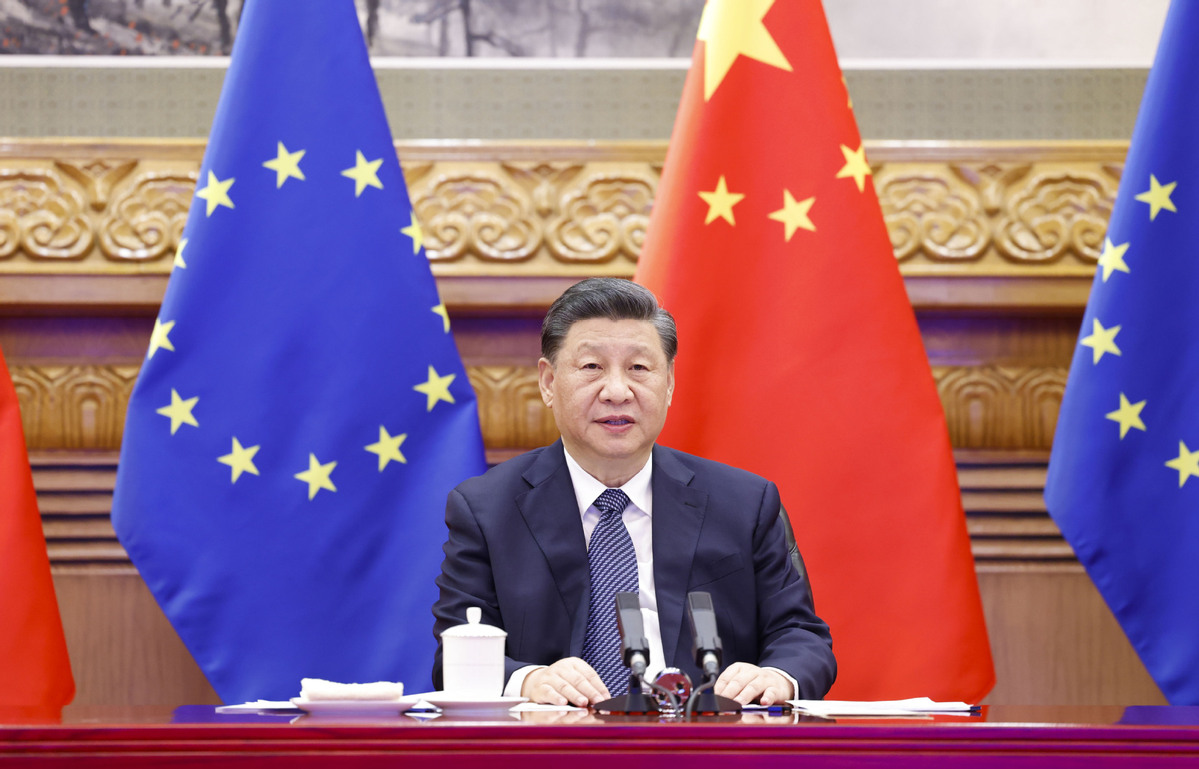
President Xi Jinping reaffirmed China's support on Friday for peace talks in resolving the Ukraine crisis, saying that China and the European Union should remain committed to bringing the situation under control and preventing a spillover of the crisis.
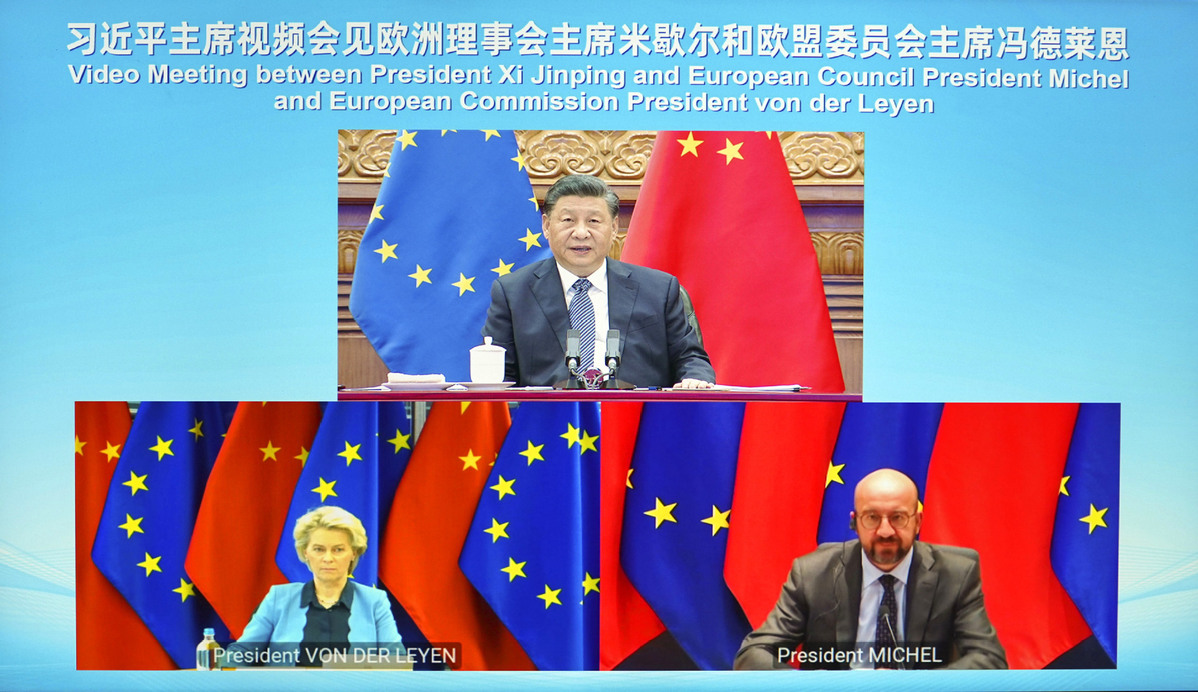
Speaking during a virtual meeting with European Council President Charles Michel and European Commission President Ursula von der Leyen, Xi said Beijing supports the endeavor made by the EU to resolve the situation in Ukraine and the nation has always been promoting peace talks in its own way.
Xi reiterated that Beijing finds it deeply regrettable about the current situation in Ukraine, saying that it has been the consistent and clear position of China to always stand on the side of peace, assess the situation independently and make judgments on the basis of the merits of the issue.
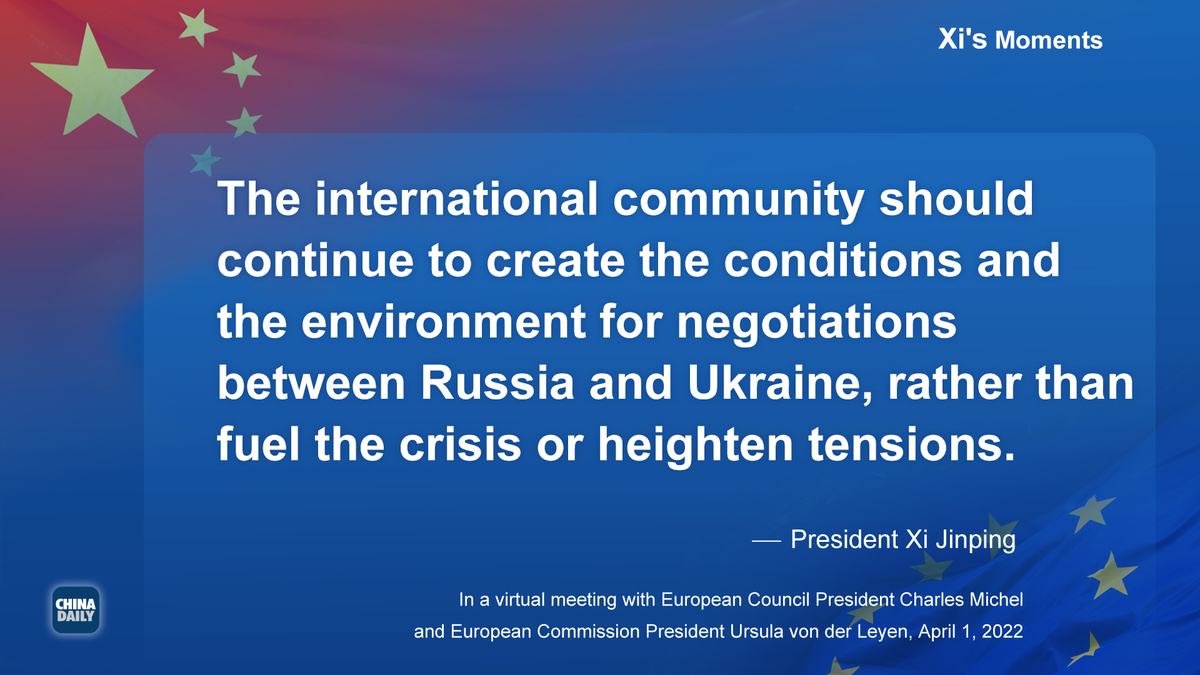
The international community should continue to create the conditions and the environment for negotiations between Russia and Ukraine, and open up space for a political settlement, rather than fuel the crisis or heighten tensions, he said.
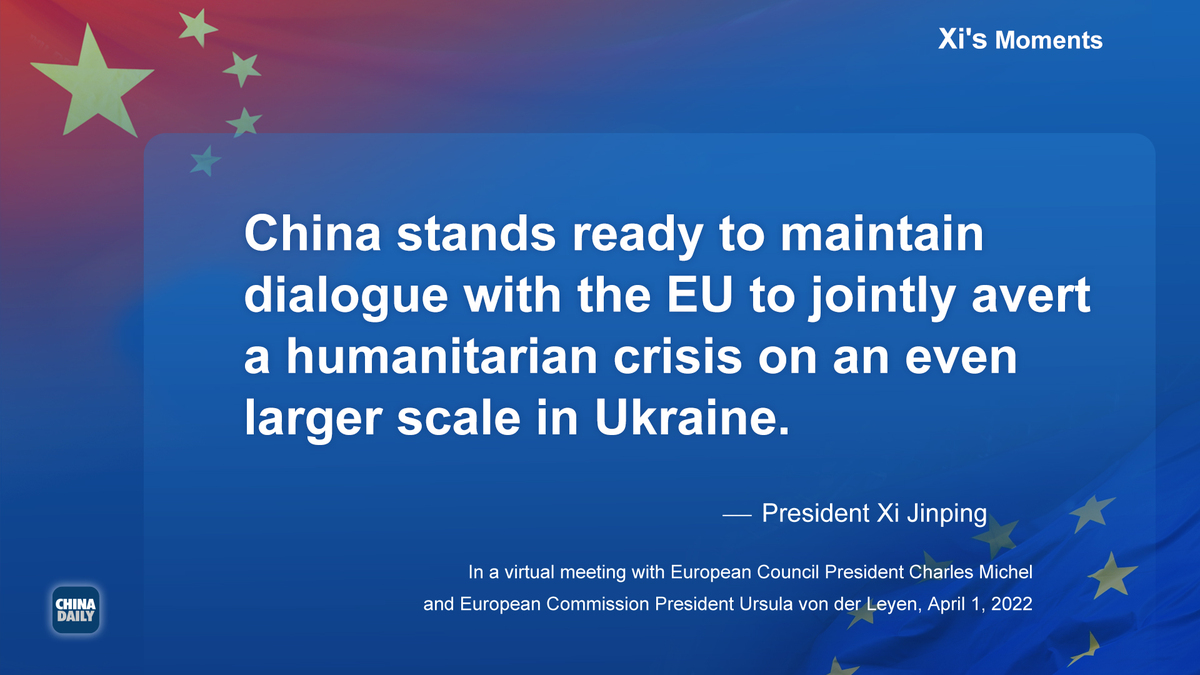
China, after having provided several batches of emergency aid to the Ukrainian side and supplies to European countries receiving large numbers of refugees, stands ready to maintain dialogue with the EU to jointly avert a humanitarian crisis on an even larger scale, he said.
The president highlighted the need to ensure lasting peace in Europe and the Eurasian continent.
The fundamental cause of the Ukraine crisis lies in the longstanding regional security conflict in Europe, and the fundamental solution is to accommodate the reasonable security concerns of various sides, he said.
He cautioned against the use of a Cold-War mentality to develop global and regional security frameworks, saying that China supports the leading role of the EU and dialogue between the EU, Russia, the United States and NATO to face up to the contradictions accumulated over the years and find a solution to problems.
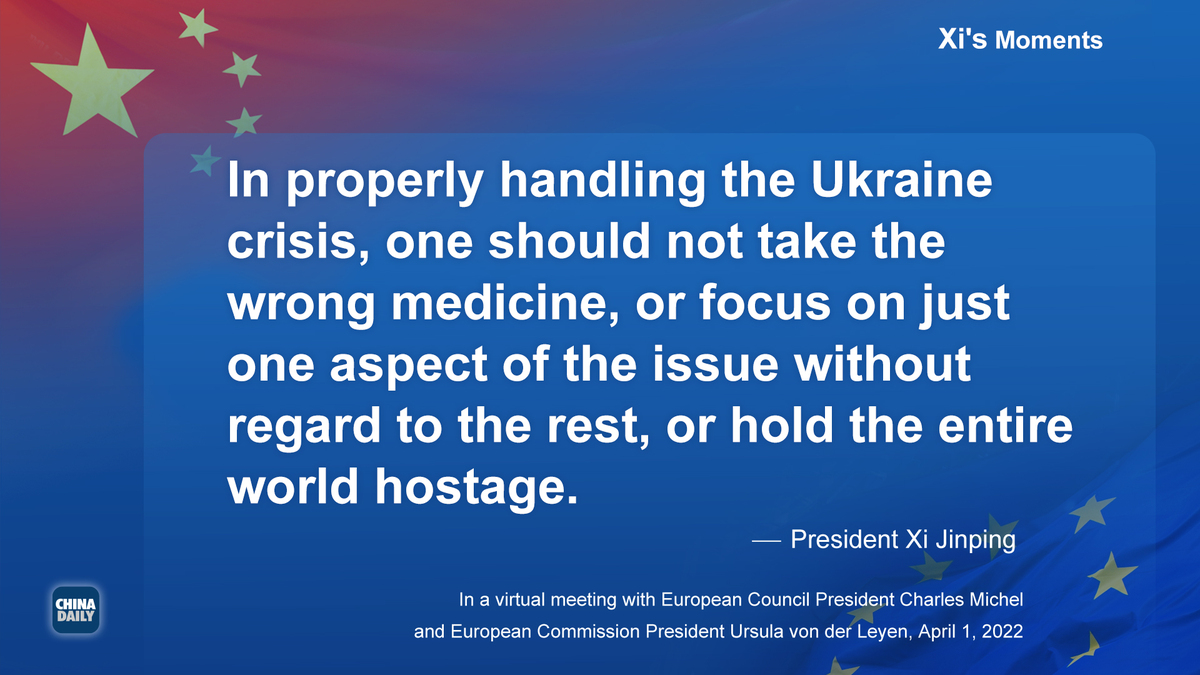
In properly handling the crisis, one should not take the wrong medicine, or focus on just one aspect of the issue without regard to the rest, or hold the entire world hostage, he said, adding that it is important to avoid making ordinary people around the world suffer as a result.
He urged various sides to cherish the current global economic landscape, saying that the global economic system cannot be disrupted at will, and attempts to politicize or weaponize the global economy as a tool to serve one's own agenda should not be allowed.
Such attempts will trigger serious crises in global finance, trade, energy, technology, food, industrial and supply chains, among others, he said.
If the situation continues to worsen, it could take several years, if not decades, to get things back on track, he said, citing the concerns of many people that the current situation may wipe out the fruits of international economic cooperation gained through decades of efforts.
China and the EU should keep the system, rules and foundation of the global economy stable in order to boost public confidence, he said.
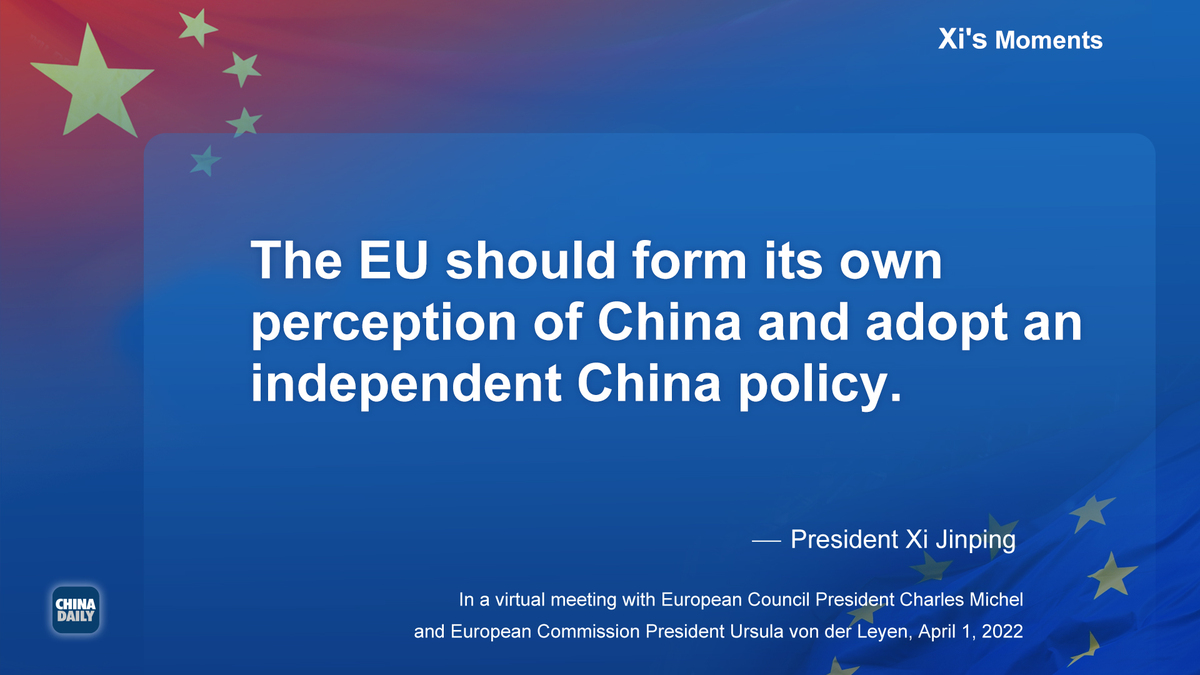
The president urged the EU to adopt an independent China policy and work with Beijing for the steady and sustained growth of bilateral relations.
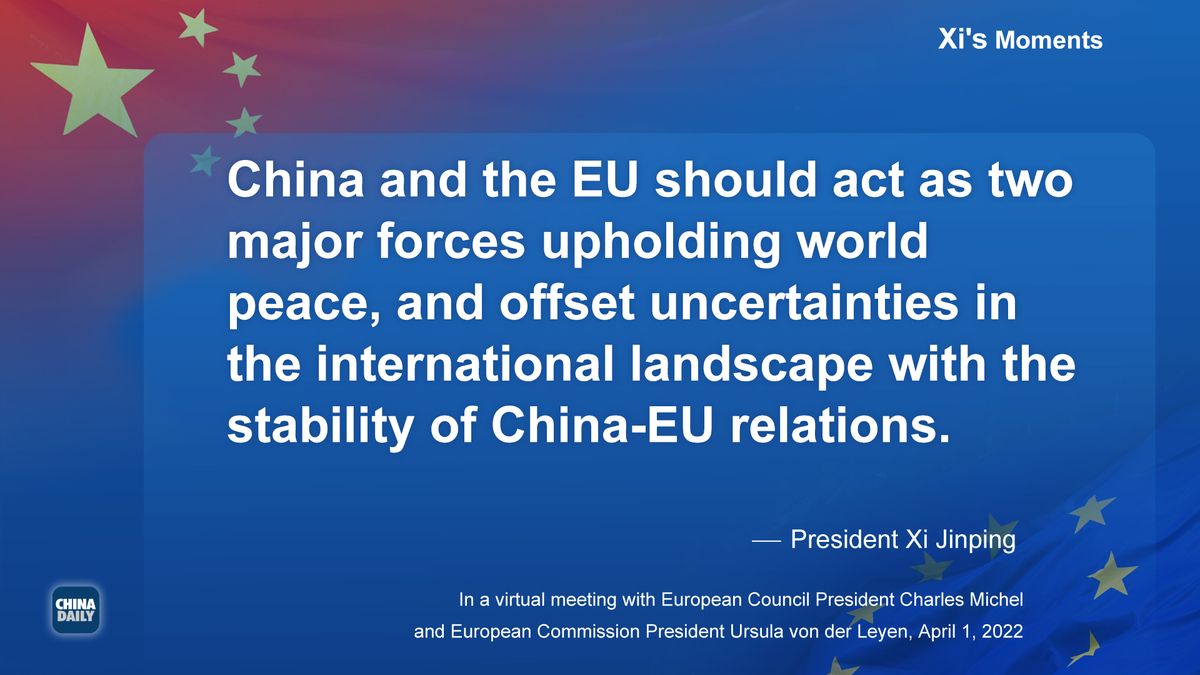
He stressed that China and the EU should act as two major forces upholding world peace, and offset uncertainties in the international landscape with the stability of China-EU relations.
The two sides should jointly reject the resurrection of a rival-bloc mentality and oppose attempts to start a new Cold War, with a view to maintaining world peace and stability, he said.
He highlighted the importance of seeking greater synergy between the development strategies of China and the EU and exploring more areas of complementarity between China's new development philosophy and paradigm and the EU's trade policy for open strategic autonomy.
The EU was China's second-largest trading partner last year, with bilateral trade reaching $828.1 billion, up 27.5 percent year-on-year.
The two EU leaders told Xi that the bloc looks forward to candid communication with Beijing to sustain the good momentum of relations, and it is willing to continue deepening cooperation in the economy, trade, investment, energy and green development.
The two sides should jointly respond to global challenges including COVID-19, climate change and the protection of biodiversity, they said.
The meeting was held after the 23rd China-EU leaders' meeting on Friday, co-chaired by Premier Li Keqiang and the two EU leaders via video link.
Beijing suggested the two sides step up policy coordination on the response to COVID, as well as climate change and the digital economy on the basis of current dialogue mechanisms to foster new highlights in bilateral cooperation, Li said.
China and the EU should jointly maintain the security of energy and grain supplies and the stability of industrial and supply chains, respond to common challenges and ensure the sustainable recovery of the global economy, he said.

WASHINGTON -- The United States has canceled a planned test-launch of its Minuteman III intercontinental ballistic missile (ICBM) in a bid to lower the nuclear tensions with Russia amid the ongoing military conflict in Ukraine, the US Air Force told Xinhua on Friday.
The US Air Force's press desk confirmed the cancellation in a phone call with Xinhua, saying the reason for the decision was the same as when the Air Force announced the delay of the test on March 2, which was to avoid misinterpretation or miscommunication with Russia during Moscow's military operation in Ukraine.
"The Department of the Air Force recently cancelled the routinely planned test flight of an LGM-30G Minuteman III missile scheduled for March 2022. The launch had been previously delayed due to an overabundance of caution to avoid misinterpretation or miscommunication during the ongoing Russian invasion of Ukraine and was cancelled for the same reason," Ann Stefanek, the spokesperson for the Air Force, later said in a statement sent to Xinhua via email.
"Our next planned test flight is later this year. The Department is confident in the readiness of the strategic forces of the United States," Stefanek added.
Russian President Vladimir Putin in February ordered his country's nuclear forces to be put on high alert, prompting Washington to call for de-escalation in what could otherwise be a potential nuclear crisis.

MOSCOW/KYIV - Negotiations between Russia and Ukraine are continuing in an online format, the head of Russia's delegation at talks with Ukraine Vladimir Medinsky said Friday.
"We are continuing negotiations in a videoconference format. Our positions on Crimea and Donbass remain unchanged," Medinsky wrote in a Telegram post.
Also on Friday, Ukraine's government-run Ukrinform news agency confirmed that Ukraine and Russia have started the next round of peace talks via video, citing a member of the Ukrainian delegation Mykhailo Podolyak.
On Thursday, another Ukrainian negotiator, David Arakhamia, said that at the fresh talks, the Ukrainian and Russian delegations will intensify efforts to work out an agreement needed for a meeting between Ukrainian President Volodymyr Zelensky and Russian President Vladimir Putin.
Russia and Ukraine held their latest round of face-to-face peace talks in Turkey's Istanbul on Tuesday, which lasted for about three hours.







