


Imperialism in a new economic guise










History tends to repeat itself, even if in a different form. In 1900, an eight-country military coalition of Britain, the United States, Germany, France, Japan, Russia, Italy, and Austria-Hungary invaded China. More than 60,000 troops marched into the country to suppress the Boxer Rebellion, trampling principles of sovereignty and symbolizing the logic of imperial power.
More than a century later, another grouping of eight countries has taken shape. This time, however, the intent is not to invade a weak state but to shield one from a bully. The country concerned is Denmark, which has faced escalating demands from the United States to hand over Greenland, its autonomous territory. At Denmark's invitation, the United Kingdom, the Netherlands, Norway, Finland, Sweden, Germany and France joined what might be informally described, by historical analogy, as a new "eight-nation alliance". Ironically, 44 hours later after its deployment, the 15-people German force withdrew from Greenland.
But the contrast between the two alliances could hardly be sharper. Whereas the 1900 alliance mobilized over 60,000 troops, the current arrangement consists of a small and largely symbolic presence. It is not a military force capable of deterring an invasion. It is less a military formation than a political statement.
The trigger is the US' explicit interest in acquiring Greenland. In his latest speech in Davos, US President Donald Trump reaffirmed his determination to acquire Greenland, expressing in the unfounded excuse — since it is part of NATO — that Denmark is too weak to protect the strategically important polar island. While Washington has framed its position in strategic and security terms, the very idea of its control over territory belonging to another state raises serious legal questions. International law prohibits territorial acquisition by coercion. Denmark's sovereignty over Greenland, and Greenland's right to self-government within that framework, are not matters open to unilateral revision.
Denmark and Greenland have made it clear that they do not consent to any transfer of sovereignty. Against this backdrop, the European alignment should be understood less as a challenge to US hegemony than as a collective affirmation of a basic principle of international law: that borders and political status cannot be altered by pressure. In this sense, the new grouping operates as a symbolic defense of the post-World War II legal order, rather than as a traditional alliance.
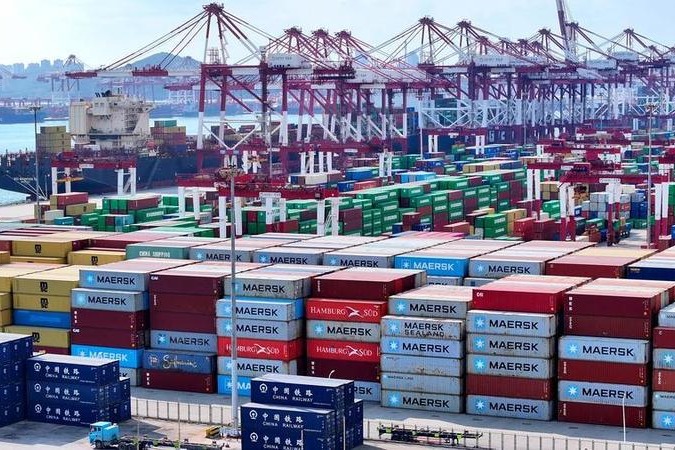
Washington's response has underscored the asymmetry of power involved. Rather than escalating the issue militarily, the US has turned to economic instruments. Washington has threatened to use tariffs against European partners as leverage in political disputes, echoing past episodes in which trade measures were deployed to advance strategic objectives. While tariffs are legitimate tools of trade policy, their use as instruments of political coercion occupies a gray area under international law, particularly when aimed at influencing decisions relating to the sovereignty of territories.
Supporters of the US position might argue that the comparison with 1900 is misplaced. They note that Washington has not deployed troops, that its actions remain within the bounds of diplomacy and trade policy, and that Greenland's strategic importance in the Arctic justifies robust negotiations among allies. From this perspective, tariffs and political pressure are seen as legitimate tools of statecraft rather than violations of international norms.
Yet this defense highlights precisely the concern at stake. International law does not prohibit negotiation or economic competition, but it draws a clear line against coercion aimed at altering sovereign choices. When economic measures are explicitly linked to forcing a change in territorial or political status, the distinction between diplomacy and compulsion becomes blurred. The absence of military force does not eliminate the legal or normative implications.
The historical analogy between the two "eight-nation alliances" should not be overstated. Today's international system is fundamentally different from that of 1900, shaped by the United Nations Charter, the norms of sovereign equality, territorial integrity and legal constraints on the use of force. Yet the comparison remains instructive precisely because it reveals what has changed, and what has not.
In 1900, collective power was used to override the sovereignty of a weaker state. In 2026, collective alignment is being used to affirm sovereignty amid pressure from a stronger power. The reversal of roles underscores the enduring tension between power and law in international affairs.
History does not repeat itself in identical form, but it does echo. The story of the two "eight-nation alliances" illustrates a persistent question at the heart of the global order: whether international relations will be governed primarily by rules and consent, or by leverage and coercion. The answer will shape not only the fate of Greenland, but also the credibility of the international legal system designed to prevent the return of imperial politics in a modern guise.
Kong Qingjiang is a professor of law and dean of the Academy for Foreign-related Rule of Law at the China University of Political Science and Law. Chen Li is a professor of law at Fudan University.
The views don't necessarily represent those of China Daily.
If you have a specific expertise, or would like to share your thought about our stories, then send us your writings at opinion@chinadaily.com.cn, and comment@chinadaily.com.cn.